
Trump secretly switches planes after Iran threat assessment
Guardian says press pool and staff left on decoy Air Force One, Democrats demand briefing on who carried the risk
Images
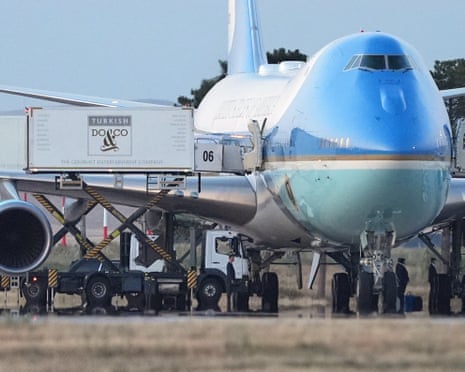 Catering trucks are parked near Air Force One as the motorcade carrying Donald Trump arrives following the Nato summit at Ankara international airport on 8 July. Photograph: Alex Brandon/AP
theguardian.com
Catering trucks are parked near Air Force One as the motorcade carrying Donald Trump arrives following the Nato summit at Ankara international airport on 8 July. Photograph: Alex Brandon/AP
theguardian.com
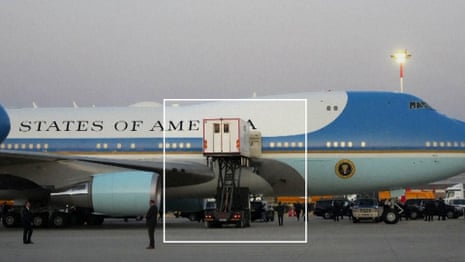 Trump ‘secretly switched planes via catering truck’ amid Iran threat | Deconstructed – video
theguardian.com
Trump ‘secretly switched planes via catering truck’ amid Iran threat | Deconstructed – video
theguardian.com
Donald Trump was secretly moved from Air Force One to a different aircraft after US intelligence identified what the Guardian describes as a credible Iranian assassination threat. The operation, carried out after the NATO summit in Turkey, involved Trump leaving the presidential jet in a catering truck and boarding a US Air Force C-32A while more than a hundred aides, officials and reporters remained on the plane they believed he was using. Democrats are now demanding a congressional briefing on what they call an unprecedented deception and the risk it imposed on people kept in the dark.
According to the Guardian, the White House publicly said Trump would fly to Britain aboard Air Force One, specifying it was the older aircraft rather than a newly refurbished Boeing 747 donated by Qatar. Trump boarded in view of television cameras, then was transferred minutes later. Reporters were instructed to keep window shades closed, and the press pool and staff on the original plane flew on without being told why the trip was being staged.
The mechanics matter because presidential travel is one of the few government routines that still depends on a compact between security services, staff and a traveling press corps. In this case, the administration appears to have treated that compact as optional: the press pool was not asked to hold back a sensitive detail; it was given a false one. Ned Price, a former national security council official in the Obama administration, told the Guardian the White House could have involved the press in withholding reporting on specific arrangements without “an outright lie,” rather than making journalists “unwitting conspirators.”
The episode also shows how risk is allocated inside a security operation. Steven Cash, a former CIA officer now at the Steady State, told the Guardian the plan appeared to reduce danger to Trump by exposing others to risk. The logic is not hard to follow: a decoy aircraft draws attention, and attention draws threats. But the people used to populate the decoy—staff who do not set policy and reporters who are there to observe it—have little ability to refuse.
Senator Richard Blumenthal of Connecticut called the operation “unprecedented and surreal” on CNN and said it was “downright scary,” pressing for a briefing on the safety precautions taken for those left aboard the original aircraft. The Guardian reports that the C-32A carrying Trump flew to RAF Mildenhall in Britain, arriving at about 10:20 pm, with the older Air Force One and the traveling press pool arriving minutes later. Photographers then captured Trump descending from the presidential aircraft after he was quietly reunited with it.
Trump greeted troops at RAF Mildenhall before boarding the Qatar-donated 747 and flying on to Washington. The decoy plane, meanwhile, had already done its job: it delivered the picture of a president leaving on schedule, and it carried the people who were not told why they were there.