
Perseid meteor shower peaks as total solar eclipse crosses parts of Europe
NBC News maps visibility from Spain to northern Russia, dark skies are widespread but totality is not
Images
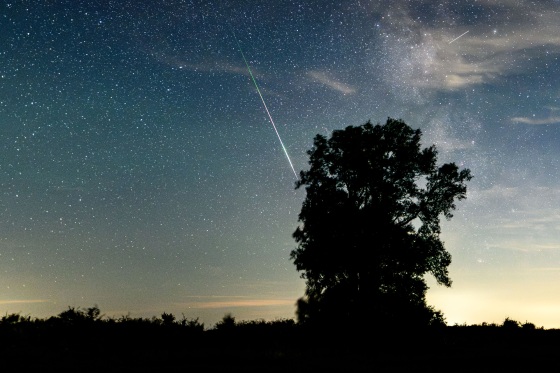 A shooting star from the Perseid meteor shower streaks across the night sky and falls behind the silhouette of a tree against the backdrop of the Milky Way
nbcnews.com
A shooting star from the Perseid meteor shower streaks across the night sky and falls behind the silhouette of a tree against the backdrop of the Milky Way
nbcnews.com
Perseid meteor activity is set to peak overnight on August 12–13 as a total solar eclipse crosses parts of Europe and the North Atlantic, according to NBC News. The meteor shower has been active since mid-July, and the eclipse’s path of totality is expected to pass over Spain, a small part of Portugal, Greenland, Iceland and northern Russia.
The overlap is unusual mostly because it compresses two different kinds of observing into the same night: long, dark hours for meteors and a brief window for an eclipse that can turn day into twilight. NBC News notes that the moon is in a new moon phase at the peak, reducing glare that often washes out fainter meteors. Under ideal conditions, the Perseids can produce up to around 100 meteors an hour at peak, with the shower known for occasional “fireballs” bright enough to leave lingering trails.
The mechanics are straightforward but the practical constraints are not. The Perseids appear when Earth passes through debris shed by comet 109P/Swift‑Tuttle, and the streaks are produced as fragments burn up in the atmosphere. Eclipse viewing, by contrast, depends on the narrow geometry of the moon’s shadow and local weather at the moment it passes overhead. Even in places inside the eclipse path, the article points out that the best meteor viewing still comes in the pre-dawn hours, when the shower’s radiant is higher; the eclipse is a separate, timed event that may occur closer to sunset in some locations.
The meeting point between the two is less about physics than about human attention and infrastructure. A meteor peak rewards patience, dark adaptation and low light pollution; eclipse travel concentrates crowds into a corridor for a short spectacle. NASA’s advice for meteor watching—give eyes 20 to 30 minutes to adjust, pick an unobstructed site—reads like the opposite of the typical eclipse-day rush between viewpoints, traffic and cloud forecasts. NASA is also planning a virtual watch party for the Perseids via YouTube, with live sky-camera views from Marshall Space Flight Center in Huntsville, Alabama, offering a controlled feed for viewers who are nowhere near the eclipse path.
The sky will do what it does either way. On the night the Perseids crest, the darkest conditions will be available to almost everyone in the Northern Hemisphere, while totality will be available only to those standing in a thin strip of shadow.