
Zelenskyy says Russia hit Zaporizhzhia with North Korean ballistic missiles
Officials report deaths and dozens injured across multiple regions, a foreign supply line shows up as civilian rubble
Images
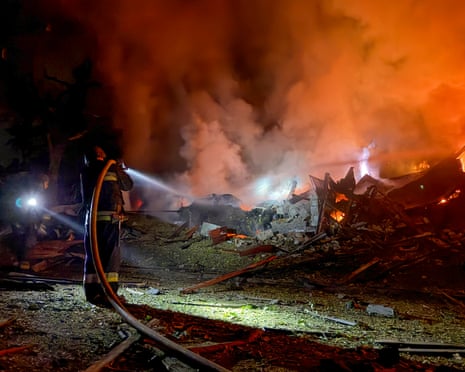 Ukrainian rescuers work at the site of a Russian attack on a residential area in Zaporizhzhia, Ukraine. Photograph: Daryna Naumova/EPA
theguardian.com
Ukrainian rescuers work at the site of a Russian attack on a residential area in Zaporizhzhia, Ukraine. Photograph: Daryna Naumova/EPA
theguardian.com
At least six people were reported killed in overnight strikes on Zaporizhzhia as Ukraine’s president said Russia used North Korean ballistic missiles alongside other weapons. Reuters, cited in the Guardian’s Europe live blog, reported another six deaths and 16 injuries in attacks on Dnipropetrovsk and Donetsk, while Ukrainian officials said 20 people were injured in Zaporizhzhia. Zelenskyy described the Zaporizhzhia strike as aimed at civilian infrastructure and said Russia was preparing escalation rather than peace.
The claim about North Korean missiles lands in a war that has increasingly become a procurement contest as much as a battlefield contest. If Russia can draw on external stockpiles and equipment, it can sustain salvos that force Ukraine to spend scarce air-defence interceptors on each wave, shifting the cost burden onto Kyiv and its backers. Ukraine, for its part, has been trying to push costs back across the border: the Guardian reported Ukrainian drone strikes deep inside Russia, including an attack in the Voronezh region in which one person was reported killed and two injured. Falling debris from that strike triggered a fire at a Wildberries logistics warehouse, according to the live blog.
Wildberries later said the fire had been extinguished, no goods were damaged, and deliveries were rerouted. The episode still illustrates a pattern that has become routine: modern wars are fought through logistics nodes that can be repaired, rerouted, or duplicated—until they cannot. Warehouses, rail junctions and power substations are not symbolic targets; they are the places where delays turn into shortages and where insurance, staffing and redundancy plans are tested under stress.
Zelenskyy also said Russia was increasing ballistic missile production and “bringing in” North Korean equipment, and claimed Moscow was preparing mobilisation. Those statements are hard to verify in real time, but they fit a conflict where each side watches the other’s industrial tempo and foreign relationships as closely as troop movements. The war’s geography has stretched beyond the front: a strike in Ukraine is now routinely paired with an incident inside Russia, and each incident is quickly folded into a narrative about who can sustain pressure longer.
Rescuers were still working at the site of the Zaporizhzhia attack as the claims circulated. By the time the debris is cleared, the argument over where the missiles came from will have moved on to the next night’s launch reports.