
New Zealand confirms newest meteorite after late July fireball
Fireballs Aotearoa recovers four fragments using 200-camera network and wind modelling, fridge magnet test and secrecy beat the meteor rush
Images
 One of four cosmic fragments found by Steve Wyn-Harris and the Fireballs Aotearoa group after a meteor lit up skies over New Zealand on 28 July. Photograph: supplied by Fireballs Aotearoa
theguardian.com
One of four cosmic fragments found by Steve Wyn-Harris and the Fireballs Aotearoa group after a meteor lit up skies over New Zealand on 28 July. Photograph: supplied by Fireballs Aotearoa
theguardian.com
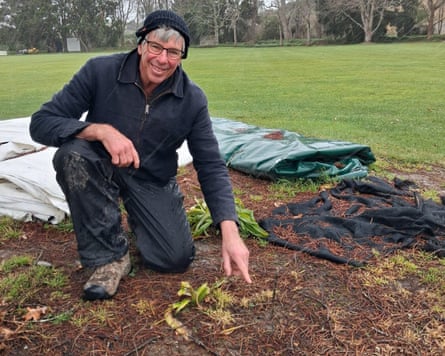 Steve Wyn-Harris on the hunt for fragments from July’s meteor. Photograph: supplied by Fireballs Aotearoa
theguardian.com
Steve Wyn-Harris on the hunt for fragments from July’s meteor. Photograph: supplied by Fireballs Aotearoa
theguardian.com
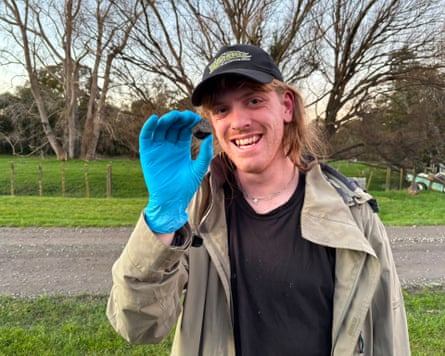 PhD student Liam McGovern with one of four fragments found by Fireballs Aotearoa after a meteor blazed over New Zealand on 28 July. Photograph: supplied by Fireballs Aotearoa
theguardian.com
PhD student Liam McGovern with one of four fragments found by Fireballs Aotearoa after a meteor blazed over New Zealand on 28 July. Photograph: supplied by Fireballs Aotearoa
theguardian.com
A meteor that lit up the skies over New Zealand in late July has yielded four recovered fragments weighing a combined 75 grams, after a citizen-science group used camera data and wind modelling to narrow the search area, The Guardian reports. The first piece—an eight-gram black stone—was spotted by Fireballs Aotearoa director Steve Wyn-Harris, who tested it with a fridge magnet and heard a distinctive click indicating iron and nickel.
The find would become New Zealand’s 11th confirmed meteorite, a small number that reflects geography as much as astronomy. Meteorites can be recovered only if someone sees the fireball, estimates where it came down, and then walks the ground before weather, vegetation, or simple bad luck hides the evidence. In New Zealand, The Guardian notes, rugged terrain and sparse population make that last step unusually hard.
Fireballs Aotearoa has built a network of about 200 cameras across the country to record meteors and reconstruct their flight paths. After people reported seeing the fireball over the North Island and hearing a “huge boom”, the group combined the camera footage with wind speed data to project where fragments might have landed. They kept the location secret to avoid a “meteor rush”, a precaution that also reflects the legal environment: New Zealand law prohibits the sale of meteorites, limiting the usual collector market that can both help and distort recoveries.
Two days after Wyn-Harris’s first find near a riverbank on farmland, a geology PhD student, Liam McGovern, found a second fragment weighing 39 grams. Over roughly 10 days, the group recovered four pieces, including one that landed on a house driveway. A geologist on a video call noted the fusion crust looked consistent with a meteorite, and further analysis is expected to confirm composition and classification.
The meteor’s trajectory suggests it came from the asteroid belt and is classified as an “ordinary chondrite”, a common type that still carries early-solar-system material largely unchanged since formation. Fireballs Aotearoa geologist Marshall Palmer is expected to analyse the fragments further and assign an official name.
For now, the most advanced instrument involved in the first confirmation was a fridge magnet. The rest was time, secrecy, and a lot of walking.