
Indian police fire teargas at job exam protesters
Recruitment drives draw hundreds of thousands of applicants for a few thousand posts, leaked papers turn administration into public order
Images
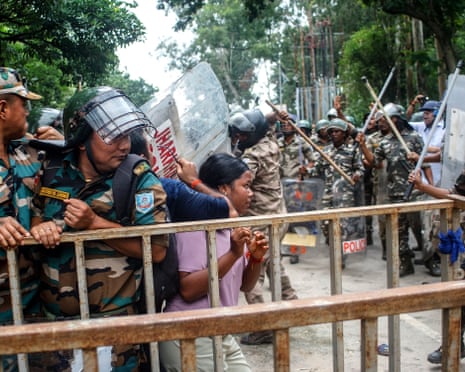 Students march towards Jharkhand’s state assembly in protests over alleged irregularities in government recruitment exams. Photograph: Yousuf Sarfaraz/AFP/Getty Images
theguardian.com
Students march towards Jharkhand’s state assembly in protests over alleged irregularities in government recruitment exams. Photograph: Yousuf Sarfaraz/AFP/Getty Images
theguardian.com
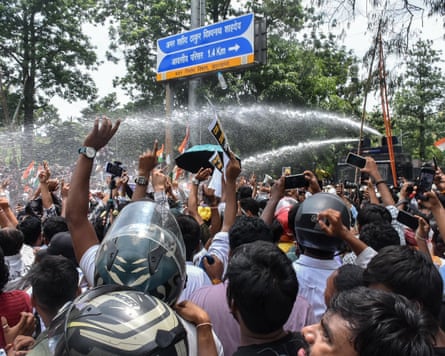 Police use water cannon to disperse demonstrators during a protest. Photograph: Rajesh Kumar/AFP/Getty Images
theguardian.com
Police use water cannon to disperse demonstrators during a protest. Photograph: Rajesh Kumar/AFP/Getty Images
theguardian.com
Thousands of young job-seekers clashed with police in Ranchi on Monday as protests over alleged irregularities in government recruitment exams intensified in India’s Jharkhand state, according to The Guardian. Police used water cannon, teargas and batons to stop demonstrators from approaching the state assembly, with injuries reported on both sides but no official figures released.
The immediate dispute is procedural—who leaked what exam paper, and whether investigators will be brought in—but the stakes are financial and generational. Government jobs in Jharkhand are described by protesters as the closest thing to guaranteed security: stable wages, health coverage and pensions in a high-unemployment environment. The Guardian reports that recruitment drives can draw hundreds of thousands of applicants for a few thousand posts, turning each exam into a high-value gatekeeper. When that gate is perceived as purchasable—through leaks, cheating networks or political influence—the losers are not abstract “candidates” but households that have paid years of coaching fees and postponed work in order to study.
The protests also sit inside a larger national pattern: a young population competing for credentialed work in an economy where formal-sector openings do not match the volume of graduates. The Guardian cites a 2026 Azim Premji University study finding nearly 40% of graduates aged 15 to 25 unemployed, alongside official data showing unemployment fell to 9.9% last year—numbers that can coexist when job growth is uneven and underemployment is widespread. The same reporting links the current agitation to the earlier “Cockroach movement” over leaks in a national medical entrance exam, a campaign that helped force the education minister’s resignation. In that context, the choice to meet crowds with crowd-control weapons is not just about dispersal; it signals that exam administration has become a public-order issue.
Jharkhand’s government—run by a regional party allied with the opposition Congress—has held talks and says most demands have been accepted, while remaining open to negotiations, according to The Guardian. Yet protesters are demanding a Central Bureau of Investigation probe, effectively asking for an outside institution to take control of the case. That request reflects a basic problem of credibility: if the body running the exams is suspected of being compromised, promises of internal reform sound like the same people re-grading their own work. The Guardian notes that the former chair of the Jharkhand public service commission has been arrested and three commission members have resigned, steps that can either demonstrate accountability or confirm that the system was penetrated.
Rahul Gandhi condemned the use of force and called for dialogue, but the mechanics of recruitment are already doing the talking. One recent drive drew nearly 640,000 applications for 2,025 posts, the paper reports; another had more than 322,000 candidates for 510 vacancies. In a state where a single paper can decide a lifetime of income and status, the street becomes the appeals process.
On Monday, some demonstrators danced and cheered even as water cannon hit them, The Guardian reports. The assembly building in Ranchi stayed protected by lines of police, while the exam system that brought the crowd there remained in place.