
Trump signs order to reshape US childhood vaccine schedule
White House seeks to split MMR and cut universal recommendations, policy relies on shots that are not licensed and visits families must repeat
Images
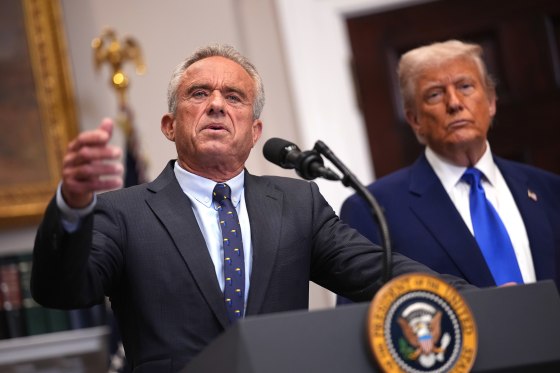
 Donald Trump shuts his eyes as Robert F Kennedy Jr speaks in the Oval Office in January 2026. Photograph: Samuel Corum/Getty Images
theguardian.com
Donald Trump shuts his eyes as Robert F Kennedy Jr speaks in the Oval Office in January 2026. Photograph: Samuel Corum/Getty Images
theguardian.com
 President Trump Announces Plan To Reduce The Cost Of Prescription Drugs
nbcnews.com
President Trump Announces Plan To Reduce The Cost Of Prescription Drugs
nbcnews.com
Donald Trump has signed an executive order aimed at rewriting the US childhood vaccination schedule, including a plan to split the combined measles, mumps and rubella shot into separate injections and to reduce the number of vaccines recommended for all children, according to The Guardian and NBC News. The order also calls for administering immunisations at separate medical visits and directs the attorney general to challenge state laws that conflict with the new federal guidance.
The immediate practical problem is that parts of the order describe a market that does not exist. NBC News notes there are no individually approved measles, mumps or rubella vaccines available in the US, meaning the promised three-shot alternative to the combined MMR would take years to license even if manufacturers chose to pursue it. Meanwhile, separating shots across multiple appointments increases the time and travel costs borne by families and raises the administrative load for paediatric practices—friction that tends to show up as missed appointments, delayed schedules and lower uptake.
The order also tries to shift decision-making away from a single national schedule and toward a patchwork of “shared clinical decision-making” for several vaccines, leaving parents and clinicians to negotiate what had previously been standard. The Guardian reports that only a subset of vaccines would retain full universal recommendations under the order, while others would move to risk-based guidance or shared decision-making. In a system where school-entry requirements are set by states and localities, and where there is no universal federal mandate, the White House cannot directly compel vaccination—but it can create legal conflict by encouraging federal challenges to state rules.
Both outlets describe the signing ceremony as anchored in claims about autism, despite decades of studies finding no link between vaccines and autism. That rhetorical choice matters less as a scientific argument than as a signal to the political base: the administration is willing to trade institutional consensus for visible action, even if the implementation depends on regulators, courts, manufacturers and state governments that may not cooperate.
The combined MMR shot has been used for decades partly to reduce the number of injections. The executive order’s preferred alternative would increase them, and it does so before the replacement product is even available.