
Daniel Kinahan returns to Ireland from Dubai
Alleged Kinahan cartel leader faces charge of directing organised crime, years of public boxing business end in a bomb-proof van ride to court
Images
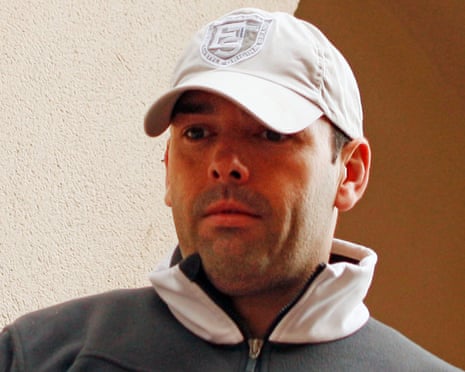 Daniel Kinahan left Ireland in 2016, first for Spain and later Dubai, where he ran a successful boxing business. Photograph: NNA/SOLARPIX.COM
theguardian.com
Daniel Kinahan left Ireland in 2016, first for Spain and later Dubai, where he ran a successful boxing business. Photograph: NNA/SOLARPIX.COM
theguardian.com
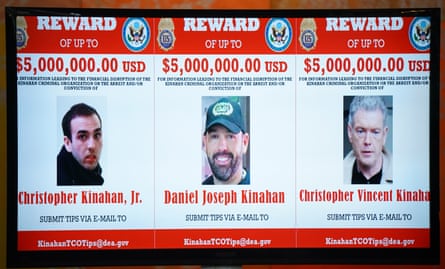 Wanted posters displayed at a press conference at Dublin City Hall after the US government announced it was offering $5m for information on the Kinahans. Photograph: Niall Carson/PA
theguardian.com
Wanted posters displayed at a press conference at Dublin City Hall after the US government announced it was offering $5m for information on the Kinahans. Photograph: Niall Carson/PA
theguardian.com
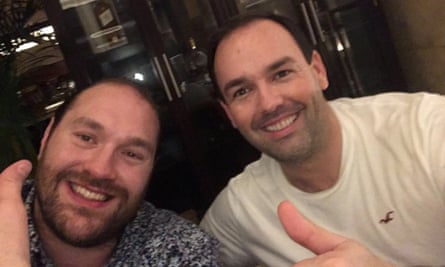 Kinahan (right) with the boxer Tyson Fury in 2020. Photograph: Unknown
theguardian.com
Kinahan (right) with the boxer Tyson Fury in 2020. Photograph: Unknown
theguardian.com
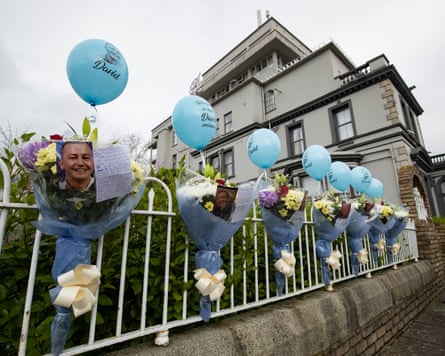 Flowers, photos and messages at the site of the former Regency hotel in Dublin, where David Byrne was shot dead during a boxing weigh-in. Photograph: Brian Lawless/PA
theguardian.com
Flowers, photos and messages at the site of the former Regency hotel in Dublin, where David Byrne was shot dead during a boxing weigh-in. Photograph: Brian Lawless/PA
theguardian.com
Daniel Kinahan was flown from Dubai to Dublin on an Irish government jet on Sunday, ending a decade-long effort to bring the alleged leader of the Kinahan organised crime group back under Irish jurisdiction. According to The Guardian, he was expected to land at Casement aerodrome under heavy security, be taken in a bomb-proof van to the criminal courts in central Dublin, and face a charge of directing organised crime before transfer to Portlaoise prison.
Kinahan left Ireland in 2016, first for Spain and later for Dubai, where he built a public-facing life around boxing management through MTK Global and cultivated relationships with high-profile fighters. The same visibility that helped commercialise boxing also offered a plausible cover story for a man long linked by investigators to drug trafficking and money laundering allegations. A 2009 US diplomatic cable cited by the paper described him as an Irish businessman involved in narco-trafficking across Europe, and the US later posted a $5 million reward for information on the Kinahans—an unusually public signal of interest that did not, by itself, dislodge him.
The case shows what extradition often depends on in practice: not just warrants and dossiers, but the willingness of a host state to make a person available. Spanish authorities previously arrested members of the Kinahan family and seized assets, yet the network remained largely intact, The Guardian reports, reflecting how seizures can become a cost of doing business when the underlying cashflows continue. Meanwhile the group is described as controlling roughly one-third of Europe’s cocaine supply, with additional involvement in firearms and racketeering—an economy large enough to finance security, lawyers, and relocation.
Ireland’s interest in a high-security landing and rapid court processing is also a measure of the group’s domestic footprint. The Kinahans’ history includes a violent feud with the rival Hutch gang and an attempted assassination of Daniel Kinahan at a boxing weigh-in at Dublin’s Regency hotel in February 2016, an episode that escalated into multiple killings. When states cannot reliably deter, they harden: the reported plan to hold him in the maximum-security A5 unit in Portlaoise is designed to prevent the prison system from becoming another arena for the organisation’s reach.
Kinahan has not yet been tried. But after years in which he could give a phone interview from Dubai to a podcaster and talk about Irish snack foods he missed, he is now back in the Irish courts—where the country’s most expensive security measures will be routine, and the verdict will be the only part that is not pre-scripted.