
British Columbia wildfire forces mass evacuation
State of emergency declared as Bald Range fire races along Okanagan Lake, helicopters diverted from firefighting to rescues
Images
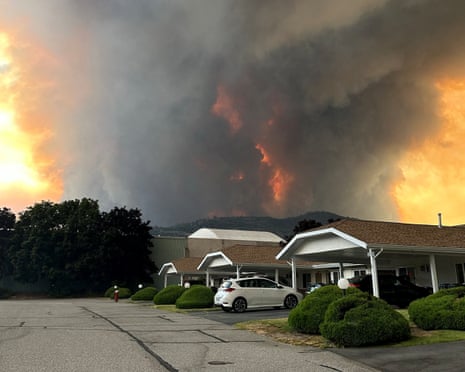 Smoke rises from the Bald Range wildfire over a residential street in Summerland, British Columbia, Canada, on 7 August. Photograph: Terry Fries/Reuters
theguardian.com
Smoke rises from the Bald Range wildfire over a residential street in Summerland, British Columbia, Canada, on 7 August. Photograph: Terry Fries/Reuters
theguardian.com
More than 20,000 people were ordered to evacuate communities along Okanagan Lake in British Columbia after a fast-moving wildfire destroyed homes and forced rescues, according to the Associated Press via The Guardian. The province declared a state of emergency after officials said hot, windy weather and prolonged drought helped drive what wildfire commanders described as “explosive” conditions. The Bald Range wildfire was first reported on a Friday evening and expanded rapidly, with officials saying it grew to about 50 square kilometres within hours.
The evacuation orders underscored a recurring problem for western North America: fires are no longer confined to remote forests, but increasingly behave like fast-moving disasters that hit towns before emergency systems can scale up. In British Columbia, officials said the fire overwhelmed the smaller community of Faulder and then advanced toward Summerland at extraordinary speed, with the entire community ordered to evacuate overnight. Provincial officials said more than 100 wildfires were burning across British Columbia at the time, with nearly half listed as out of control.
The state of emergency gives the province additional powers, including restricting travel and securing accommodation for evacuees that might otherwise be unavailable, British Columbia’s emergency management minister Kelly Greene said, as cited by AP. On the ground, the fire response also became a rescue operation: Cliff Chapman, director of wildfire operations for the BC Wildfire Service, said helicopters that would normally be used to fight the fire were diverted to evacuate people who could no longer escape by road. Search-and-rescue crews continued to look behind fire lines for anyone else who might have been caught, while officials said they had not yet determined how many homes were destroyed.
AP described residents becoming trapped and needing to be rescued, with social media videos showing homes burning as traffic backed up on roads bordered by flames. One homeowner told AP she and her husband fled after midnight after watching the fire spread beyond nearby mountains; they had packed bags, prepared a carrier for their cat, and planned to help a disabled friend evacuate, but ultimately left to avoid being caught.
British Columbia’s premier David Eby announced the emergency while officials warned that other communities could face similar fires if conditions persist. The immediate question for evacuees is not modelling or policy but logistics: where to sleep, how long the roads stay open, and what is left when they return.
By Saturday, officials were still searching behind the fire lines, and firefighting helicopters were still being used to pull people out rather than to douse the blaze.