
Appeals court halts White House ballroom project
National Trust lawsuit says Congress must approve major changes to Executive Residence, East Wing was already demolished
Images
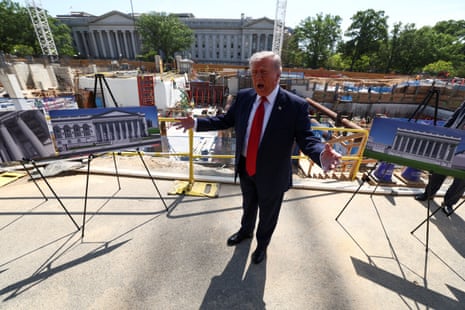 Donald Trump at the site of construction of the planned White House ballroom in Washington DC on 19 May 2026. Photograph: Kevin Lamarque/Reuters
theguardian.com
Donald Trump at the site of construction of the planned White House ballroom in Washington DC on 19 May 2026. Photograph: Kevin Lamarque/Reuters
theguardian.com
A US federal appeals court has ordered the Trump administration to halt construction of a planned White House ballroom, a project the Guardian describes as costing $400 million. According to the Guardian, the Washington-based Court of Appeals for the District of Columbia Circuit upheld a preliminary injunction in a divided 2–1 decision, while pausing its order for two weeks to let the administration seek Supreme Court review.
The lawsuit was brought by the National Trust for Historic Preservation after the administration tore down the White House’s East Wing and began building what the complaint describes as a 90,000-square-foot hospitality facility without seeking congressional authorisation. The appeals court majority—Judges Patricia Millett and Bradley Garcia—framed the dispute as one of ownership and control: presidents are “temporary tenants” of the Executive Residence, they wrote, and Congress decides what may ultimately be built. The ruling does not weigh whether a ballroom is a good idea; it focuses on whether the executive branch can commit the country to a major alteration of a national monument on its own authority.
The case turns a familiar Washington argument into a concrete procurement problem. If Congress must authorise the project, legislators can attach conditions, demand costings, and force a public record of who is paying and who is contracting. If the White House can proceed unilaterally, the effective check becomes litigation after demolition has already occurred. The Guardian notes that an earlier district court ruling in April allowed only underground construction that a judge deemed necessary on national security grounds, blocking the larger entertainment facility. That sequencing matters: once excavation and security-related works are underway, the line between “necessary” and “nice to have” is policed by lawyers and contractors rather than appropriators.
Judge Neomi Rao, a Trump appointee, dissented and sided with the president’s claim that the project falls within his authority. The split illustrates how disputes over separation of powers often end up routed through administrative details—property, permits, and appropriations—rather than grand constitutional speeches. It also places the Supreme Court in the position of deciding, on an emergency timeline, whether to let construction continue while the underlying case is litigated.
The injunction now stands, meaning the defendants may not build the ballroom during the district court proceedings without Congress’s authorisation, the majority said. The East Wing, the Guardian reports, was already demolished last year.