
Claw machine arcades spread across Hong Kong
More than 2500 shops fill post-pandemic vacancies, complaint surge and licence loophole leave odds disputes to consumers
Images
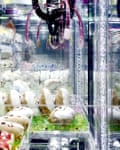 Claw machines in Hong Kong
theguardian.com
Claw machines in Hong Kong
theguardian.com
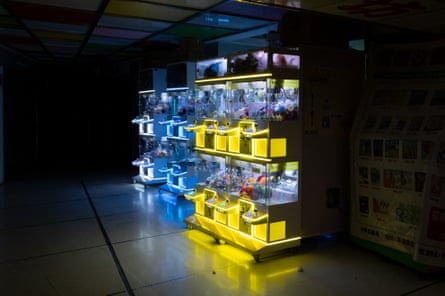 Claw machines glow in the dark in Kwai Chung Plaza, Hong Kong.
theguardian.com
Claw machines glow in the dark in Kwai Chung Plaza, Hong Kong.
theguardian.com
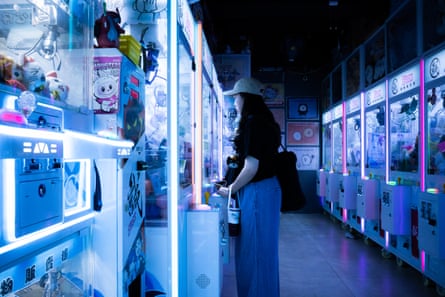 Some venues in Hong Kong are open 24 hours a day.
theguardian.com
Some venues in Hong Kong are open 24 hours a day.
theguardian.com
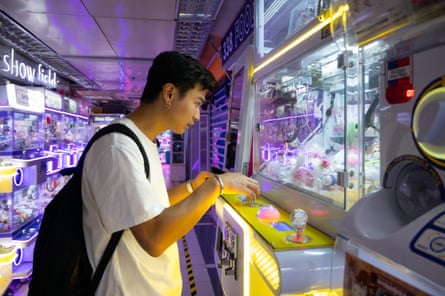 Jerry, 27, a property management officer, plays a claw machine in Kwai Chung Plaza.
theguardian.com
Jerry, 27, a property management officer, plays a claw machine in Kwai Chung Plaza.
theguardian.com
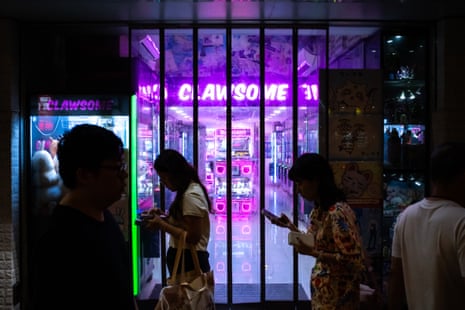 Claw machines are unregulated in Hong Kong, raising concerns they could lead to addictive behaviour.
theguardian.com
Claw machines are unregulated in Hong Kong, raising concerns they could lead to addictive behaviour.
theguardian.com
More than 2,500 claw-machine shops now operate across Hong Kong, according to The Guardian, filling street-level units that went dark after the pandemic. The machines dispense plush toys, Labubu dolls and Pokémon collectibles, and some venues run around the clock. The boom has turned what used to be a sideline in malls into a standalone retail category, with players ranging from casual passers-by to repeat customers who organise their social lives around monthly sessions.
The shops’ appeal is partly aesthetic—bright lights, cute prizes, a low-stakes promise of a win—but the economics are more durable than the décor. A claw-machine operator can rent a small unit that would struggle to attract a café or boutique and keep staffing minimal, especially when payment is automated and opening hours stretch late. Players describe mechanisms that mimic chance—one radiographer told the paper she plays machines with a “lucky draw” feature akin to rolling dice—creating a rhythm of near-wins and small payouts that keeps money moving through the slot. For some customers, the goal is any prize; for others, it is a specific rare item that might later be resold, turning a toy into a speculative ticket.
That mix of cheap premises, fast turnover and repeat play has also produced a familiar dispute: whether the game is being quietly rigged. Serious players told The Guardian they suspect operators narrow prize chutes using toothpicks, needles, or strips of plastic or metal, and that machine settings can be adjusted to lower the odds. A frequent player cited in the report said he had spent more than HK$4,000 in a single arcade session and complained about prize holes being narrowed or sealed. Hong Kong’s Consumer Council, meanwhile, reported complaints rising from 16 in 2023 to 138 in the previous year, a jump that tracks the shops’ rapid spread.
Regulation has lagged behind the storefronts. A 2022 court ruling exempted claw machines from public entertainment licences, leaving the sector largely outside the usual oversight that applies to other coin-operated amusements. In May, Hong Kong’s home and youth affairs bureau proposed tighter rules, including warnings about addiction risks—an attempt to treat the machines less like harmless toys and more like a product designed to monetise compulsion. The friction is practical as well as moral: if the machines are unlicensed, enforcement relies on consumer complaints and after-the-fact disputes rather than routine inspections.
The Guardian’s reporting also shows why the industry is hard to police socially. Some owners cast themselves as community figures: one machine owner interviewed said he posts messages such as “Remember to be happy” and sometimes gives away plush toys to customers who fail to win. Another player described collecting around 100 plushies over two years as a way to relax. In a city where retail space is expensive and leisure is compressed into shopping centres and transit corridors, the machines offer a small, repeatable hit of entertainment that fits into a lunch break—and into a landlord’s vacancy problem.
On the ground, the craze looks like a row of glass boxes and soft toys; on the balance sheet, it looks like a low-labour business occupying the exact kind of empty unit that used to be someone else’s livelihood.