
Explosive drone found at Leipzig airport
DHL cargo jet aborts landing and later hits unidentified object after takeoff, critical infrastructure security collides with high-throughput logistics
Images
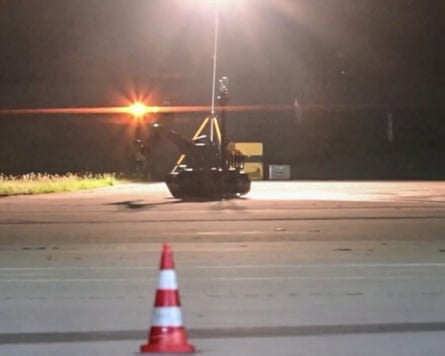
 A forensic technician works alongside a bomb disposal robot at Leipzig airport on Wednesday. Photograph: Hendrik Schmidt/DPA/AP
theguardian.com
A forensic technician works alongside a bomb disposal robot at Leipzig airport on Wednesday. Photograph: Hendrik Schmidt/DPA/AP
theguardian.com
 Footage by News5 shows the nose of an Ukrainian Antonov plane at Leipzig-Halle airport. Photograph: News5/AFP/Getty Images
theguardian.com
Footage by News5 shows the nose of an Ukrainian Antonov plane at Leipzig-Halle airport. Photograph: News5/AFP/Getty Images
theguardian.com
 German media reported that investigators were examining several possibilities, including that the incident was an attempt by Russia to attack Ukrainian equipment in Germany. Photograph: News5/AFP/Getty Images
theguardian.com
German media reported that investigators were examining several possibilities, including that the incident was an attempt by Russia to attack Ukrainian equipment in Germany. Photograph: News5/AFP/Getty Images
theguardian.com
A quadcopter fitted with explosives was found inside the cargo operations area at Leipzig airport this week, prompting runway disruption and a bomb-disposal operation, according to The Guardian. German officials said a DHL cargo aircraft aborted a landing and later suffered a mid-air collision with an unidentified object after takeoff; the plane landed safely elsewhere with minor damage reported.
The episode lands in a part of Europe’s security map where civilian logistics, military supply chains and commercial aviation share the same concrete. Leipzig is described by The Guardian as a major shipping hub and a NATO and German military logistics node, and it also hosts Ukraine’s Antonov Airlines base in Europe. That mix makes “critical infrastructure” less a category than a timetable problem: cargo flights run on tight slots, security checks are designed to keep goods moving, and any closure forces diversions that cascade through networks built for speed.
Germany’s interior minister Alexander Dobrindt said the incident did not look like amateur work and that investigators were treating it as a “professional hybrid threat scenario”, while leaving open the possibility of foreign involvement. German outlets cited by The Guardian reported the device contained PETN, a high explosive associated with military-grade materials; Bild speculated about improvised components. The divergence matters because it points to the two realities airports now have to price in at once: cheap drones that anyone can buy, and explosives that are harder to source without a supply chain.
Officials did not publicly name a suspect, but the airport’s role in supporting Ukraine and Germany’s recent history of sabotage concerns push attention in one direction. Ukraine’s ambassador to Germany, Oleksii Makeiev, blamed Moscow on television, while a NATO official confirmed awareness of the incident and said German authorities were investigating. The political demand is for attribution; the operational demand is for prevention, and those are not the same task.
Airports can harden perimeters, add sensors and expand patrols, but each layer adds cost and friction to a business that competes on throughput. The cargo plane that clipped an unknown object after takeoff became part of the case file, not because it crashed, but because it did not.
Leipzig reopened after the device was destroyed. The airport’s next departures still rely on workers spotting what the system did not.