
Rare snow falls in Wellington after Antarctic cold snap
Dunedin residents ski down Guinness-listed steepest street, grid operator records record electricity demand and warns of shortfall
Images
 Snow in the New Zealand city of Dunedin. Photograph: Mark Stevenson
theguardian.com
Snow in the New Zealand city of Dunedin. Photograph: Mark Stevenson
theguardian.com
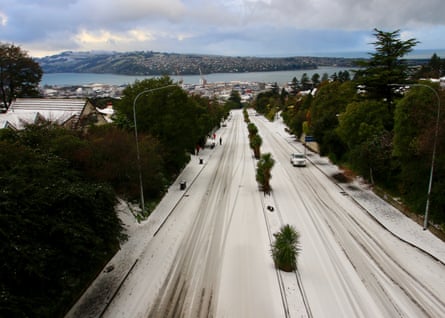 Snow on Dunedin streets on Tuesday. Photograph: Mark Stevenson
theguardian.com
Snow on Dunedin streets on Tuesday. Photograph: Mark Stevenson
theguardian.com
Snow fell in Wellington for the first time in years this week, while residents in Dunedin took advantage of the cold snap to ski and snowboard down city streets, including Baldwin Street, listed by Guinness World Records as the world’s steepest street. The Guardian reports that the Antarctic front brought hail, frosts and road closures across New Zealand, with conditions persisting into Wednesday morning.
The weather was notable not just for novelty but for the way it stressed ordinary systems. Police responded to multiple incidents of cars sliding off icy roads and urged the public to avoid travel. Christchurch saw a plane abort its landing at the international airport because of wind and rain, a reminder that “just weather” quickly becomes a logistics problem when runways, highways and emergency services all face the same constraint at once.
The cold also showed up in the electricity numbers. Transpower, New Zealand’s national grid operator, recorded the highest-ever power use during Wednesday morning’s peak, and warned of a potential energy shortfall later in the week. Peaks matter because they are expensive: spare generation and grid capacity sit idle most days, then become critical during a few hours when heaters and heat pumps switch on together.
New Zealand’s geography makes these events feel uneven. Snow reached sea level in Wellington just after midday on Tuesday, drawing office workers outside and prompting a wave of social media footage. On the South Island, students in Dunedin were sent home as snow settled, while parts of the North Island’s east coast saw thick hail storms. When the same front produces different hazards—ice on roads in one region, wind shear for aircraft in another—the cost is borne by local authorities and travellers who cannot easily substitute routes.
Forecasts suggested a brief warm-up, followed by another overnight plunge, with Thursday expected to be the coldest morning of the year in some areas. That timing matters for households and businesses because it stretches demand across multiple days, reducing the chance to “catch up” on deferred travel or energy use.
In Dunedin, the most visible response was recreational: a skier filmed descending Baldwin Street as the city turned into an improvised slope. Transpower’s warning, by contrast, was administrative and forward-looking.
Both were triggered by the same cold air moving north from Antarctica.