
SpaceX Falcon 9 stage set to crash into the moon
Uncontrolled upper stage drifts since 2025 launch and becomes an accidental impact experiment, NASA plans before-and-after imaging as disposal remains optional
Images
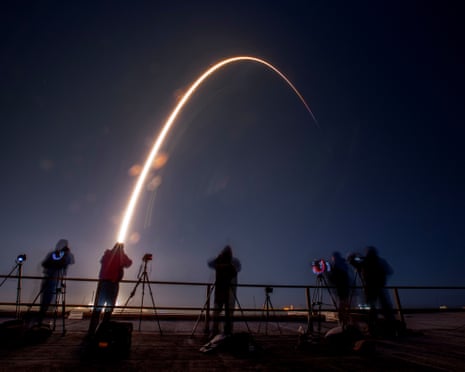 A SpaceX Falcon 9 rocket lifts off on 15 January 2025. Part of the rocket will crash into the moon on Wednesday. Photograph: Cristóbal Herrera/EPA
theguardian.com
A SpaceX Falcon 9 rocket lifts off on 15 January 2025. Part of the rocket will crash into the moon on Wednesday. Photograph: Cristóbal Herrera/EPA
theguardian.com
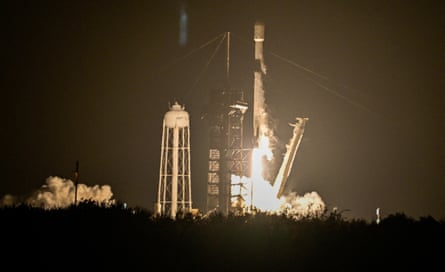 The SpaceX Falcon 9 rocket lifts off from the Kennedy Space Center in January 2025. Photograph: Steve Nesius/Reuters
theguardian.com
The SpaceX Falcon 9 rocket lifts off from the Kennedy Space Center in January 2025. Photograph: Steve Nesius/Reuters
theguardian.com
A four-tonne piece of a SpaceX Falcon 9 rocket is expected to hit the moon on Wednesday morning, after more than a year in an uncontrolled orbit following a 2025 launch. The Guardian reports the second stage is projected to strike at high speed and carve out a fresh crater, while NASA plans before-and-after imaging to document the impact site.
Unplanned lunar impacts are rare but no longer unprecedented. A Chinese rocket stage struck the moon in 2022, and NASA has previously used deliberate crashes to study plumes and surface composition; the difference here is that the object was not intended to become a projectile. According to the Guardian, the Falcon 9 stage could not be commanded once it had vented remaining fuel, leaving its trajectory to be nudged by solar activity and gravitational perturbations until astronomers concluded it was moon-bound.
The episode sits at the intersection of exploration and housekeeping. Most upper stages are designed to re-enter Earth’s atmosphere or be disposed of in controlled ways, because leaving hardware adrift turns tracking into a permanent cost. Lunar missions complicate that logic: higher-energy trajectories can strand stages in cislunar space rather than sending them back to burn up, and once a stage is inert, the marginal cost of “doing nothing” is near zero for the operator while the monitoring burden shifts to researchers and agencies.
NASA scientists quoted by the paper say the impact poses no danger to Earth, and Bill Gray, whose software work has helped flag such trajectories, describes it as minor scientific interest. Yet NASA still intends to collect data, because artificial impacts are one of the few repeatable experiments available on the lunar surface. Each new crater becomes a calibration point for impact physics, dust behaviour, and future surface operations—especially as more missions aim for the same limited set of landing zones.
The rocket stage is expected to strike a hard-to-observe region near the moon’s western limb. After the dust settles, the most visible output may be a set of new “before” and “after” images in NASA’s archive showing where a piece of hardware ended up once nobody could steer it anymore.