
LA Eaton wildfire report blames out-of-service utility tower
Investigators cite electrical arcing that ignited brush in seconds, liability fight shifts from cause to warnings and water
Images
 Trees sway in high winds as the Eaton Fire burns in Altadena in January last year. Photograph: Ethan Swope/AP
theguardian.com
Trees sway in high winds as the Eaton Fire burns in Altadena in January last year. Photograph: Ethan Swope/AP
theguardian.com
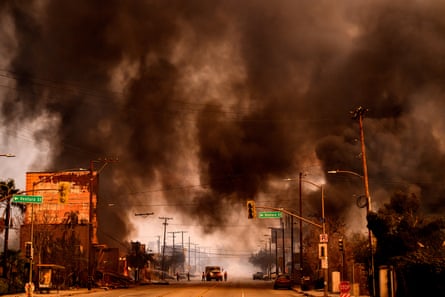 The Eaton fire in Altadena in January 2025. Photograph: Josh Edelson/AFP/Getty Images
theguardian.com
The Eaton fire in Altadena in January 2025. Photograph: Josh Edelson/AFP/Getty Images
theguardian.com
Los Angeles County fire officials say the deadly Eaton wildfire in January 2025 was sparked by electrical arcing on an out-of-service utility tower, according to a long-awaited investigative report cited by The Guardian. The blaze killed 19 people, destroyed or damaged more than 9,000 homes and businesses, and burned 22 square miles, investigators found. Southern California Edison said it has received the report and is reviewing it.
The finding lands in the middle of a familiar California cycle: extreme weather creates a narrow window where a single failure can cascade into a regional disaster, and the formal attribution arrives long after the smoke has cleared. Investigators said two arcing events happened in quick succession, with burning material falling from the tower and igniting dry brush below; within seconds the fire spread into the San Gabriel Mountains and across multiple communities. Firefighters took weeks to fully contain it.
The report’s focus on an out-of-service tower puts maintenance and decommissioning practices under the same spotlight as active transmission lines. Utilities are expected to operate and maintain equipment to minimize wildfire risk, but the public record often fills in after the fact through technical reconstructions and litigation. Southern California Edison has already acknowledged its equipment was likely associated with the ignition, while also filing lawsuits arguing county agencies failed to send timely evacuation warnings and that water agencies did not provide enough water as the fire spread, according to the report.
That legal posture—causation on one side, downstream response on the other—shows how liability is contested across the whole chain of events: ignition, warning, evacuation, and firefighting capacity. It also leaves homeowners and local governments paying immediate costs while institutions debate which failure mattered most. The Eaton fire burned at the same time as the Palisades fire, which The Guardian describes as the most destructive blaze in Los Angeles to date, another reminder that overlapping disasters strain the same crews, water systems, and communications channels.
One of the first 911 calls described a small fire at the base of a high-voltage tower. Eighteen months later, the official cause is a piece of equipment that was not even in service.