
Seoul faces first severe heatwave warning
South Korea reports 16 heat-linked deaths and record 42.5C in Yangsan, emergency trucks and drones scale up while air-conditioning load tests the grid
Images
 People cool off in the Cheonggyecheon stream in Seoul as a ‘severe heatwave warning’ has been issued for the capital of South Korea. Photograph: Greg Baker/AFP/Getty Images
theguardian.com
People cool off in the Cheonggyecheon stream in Seoul as a ‘severe heatwave warning’ has been issued for the capital of South Korea. Photograph: Greg Baker/AFP/Getty Images
theguardian.com
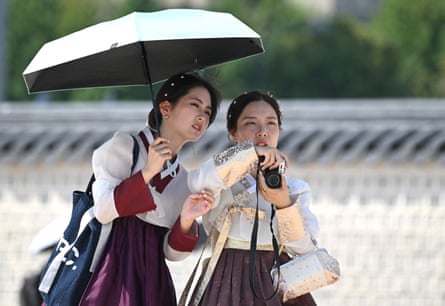 Tourists wearing traditional Hanbok dresses use a parasol to shield themselves from the sun at the Gyeongbokgung Palace in Seoul. Photograph: Jung Yeon-Je/AFP/Getty Images
theguardian.com
Tourists wearing traditional Hanbok dresses use a parasol to shield themselves from the sun at the Gyeongbokgung Palace in Seoul. Photograph: Jung Yeon-Je/AFP/Getty Images
theguardian.com
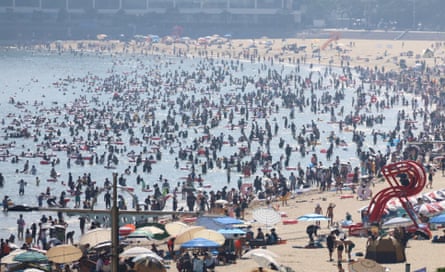 People flock to Haeundae beach in Busan amid the sweltering heat. Photograph: YONHAP/EPA
theguardian.com
People flock to Haeundae beach in Busan amid the sweltering heat. Photograph: YONHAP/EPA
theguardian.com
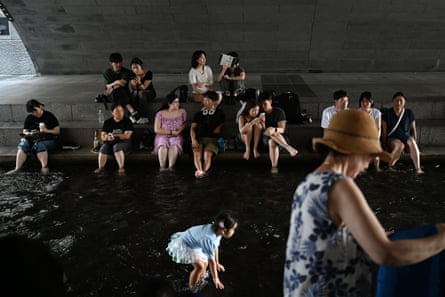 People cool off under a bridge over the Cheonggyecheon stream in Seoul. Photograph: Greg Baker/AFP/Getty Images
theguardian.com
People cool off under a bridge over the Cheonggyecheon stream in Seoul. Photograph: Greg Baker/AFP/Getty Images
theguardian.com
A national temperature record of 42.5C in the south-eastern city of Yangsan has been followed by Seoul’s first-ever “severe heatwave” warning under a system introduced in 2024, as South Korea’s heat-linked death toll since May rises to 16. According to The Guardian, the heat is shifting west towards the capital, where forecasts point to 38C followed by several days near 37C. The Korea Disease Control and Prevention Agency has treated more than 2,000 people for heat-related illness since May.
The immediate response is being run like a logistics problem. Seoul has mobilised nurses to check on up to 63,000 vulnerable residents, including elderly people and those with disabilities or chronic illnesses, and deployed about 200 trucks to spray water across nearly 2,000 km of roads, up to six times a day. In North Gyeongsang province, officials are flying drones with loudspeakers to broadcast safety messages, and using thermal imaging to monitor crowded holiday areas. President Lee Jae Myung used a cabinet meeting to order inspections of power systems as air-conditioning demand climbs, and called for a “fundamental overhaul” of the country’s crisis-response system.
The measures point to a familiar constraint: the state can broadcast warnings and push visible interventions, but the costs land unevenly on people who cannot opt out of the heat. The Guardian describes outdoor workers taking short breaks without fans, and service workers comparing poorly ventilated workplaces to a sauna. Delivery riders and construction crews are exposed precisely because they keep the city functioning when others retreat indoors. Meanwhile, power-system inspections become a proxy for a larger question of capacity: keeping millions of private air-conditioners running at once is a test of grids, fuel supply, and maintenance regimes that are normally judged only after they fail.
South Korea’s meteorological agency attributed the heatwave to overlapping high-pressure systems over the peninsula, a reminder that “adaptation” is not a single project but an ongoing operational burden. As warnings become more granular and the language of emergency more routine, the political demand shifts from acknowledging extreme weather to paying for the infrastructure that makes it survivable.
On Monday, Seoul’s Guro district reportedly hit 39C. By Tuesday, the city is expected to be under its highest heat alert while officials watch the power system that has to carry the air-conditioning load.