
Olive oil prices set to rise again as European heat damages crops
France and Spain report sharp losses across vegetables cereals and grapes, UK shoppers still pay more than £7 for a litre before the next squeeze
Images
 A farm worker uses olive branches to extinguish flames during a wildfire in the Megara valley, Greece on Sunday. Photograph: Louisa Gouliamaki/Reuters
theguardian.com
A farm worker uses olive branches to extinguish flames during a wildfire in the Megara valley, Greece on Sunday. Photograph: Louisa Gouliamaki/Reuters
theguardian.com
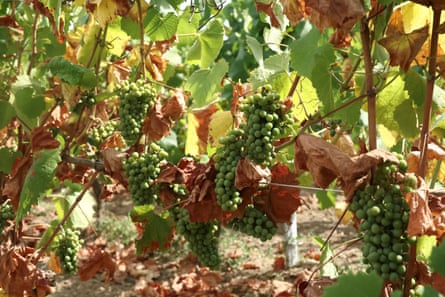 Grapes hang on vines in a drought-affected Muscadet vineyard in Saint-Fiacre-sur-Maine near Nantes. Photograph: Stéphane Mahé/Reuters
theguardian.com
Grapes hang on vines in a drought-affected Muscadet vineyard in Saint-Fiacre-sur-Maine near Nantes. Photograph: Stéphane Mahé/Reuters
theguardian.com
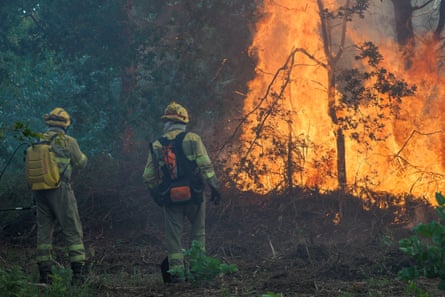 Forest firefighters try to extinguish a wildfire in Sierra do Careon in Palas de Rei, Lugo, Spain. Photograph: Eliseo Trigo/EPA
theguardian.com
Forest firefighters try to extinguish a wildfire in Sierra do Careon in Palas de Rei, Lugo, Spain. Photograph: Eliseo Trigo/EPA
theguardian.com
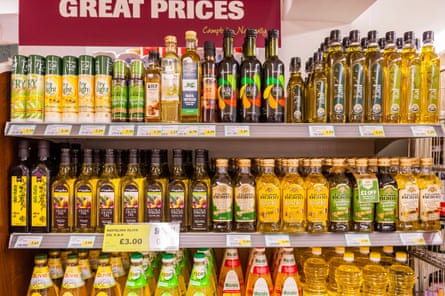 Prices for a one-litre bottle of extra virgin oil remain above £7 on average and have begun rising again in recent months. Photograph: Oramstock/Alamy
theguardian.com
Prices for a one-litre bottle of extra virgin oil remain above £7 on average and have begun rising again in recent months. Photograph: Oramstock/Alamy
theguardian.com
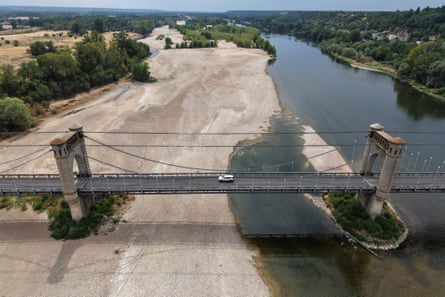 The Loire river in Langeais near Tours. Drought conditions have worsened amid heatwaves and water shortages across much of France. Photograph: Stéphane Mahé/Reuters
theguardian.com
The Loire river in Langeais near Tours. Drought conditions have worsened amid heatwaves and water shortages across much of France. Photograph: Stéphane Mahé/Reuters
theguardian.com
Olive oil prices face another lift as European heat hits harvests, farmers report losses from drought and wildfires across multiple crops, supermarket bottles stay expensive even before the next squeeze
In Greece’s Megara valley on Sunday, a farm worker used olive branches to beat back flames during a wildfire, an image that captures the season’s agricultural risk in miniature, according to The Guardian. Across Europe, farmers are warning of slumping output and higher food prices as extreme heat, drought and fires hit crops, with olive groves among the most exposed.
The Guardian reports that the cost of olive oil, already elevated, is expected to rise again. In the UK, it notes, a one-litre bottle of extra virgin olive oil remains priced above £7 on average. The pressure is not limited to olives: France’s vegetable growers’ association Légumes de France said thousands of tonnes of produce worth tens of millions of euros have been lost, including salad leaves, carrots, leeks, garlic and onions, and some crop production is expected to be halved because of a lack of rain.
Wine regions are also being pulled forward by heat. The Guardian says high temperatures in France have delayed grape growth in Champagne, Bordeaux and Burgundy, while Champagne expects its earliest harvest ever, likely starting around 15 August—about a month earlier than would have been typical decades ago. Even where grapes ripen earlier, the report adds, yields are expected to be smaller, with Champagne’s grape output forecast to be about 10% down on the previous year.
In Spain, the ministry of agriculture predicts the 2026–27 cereal crop will fall from 24 million tonnes last year to a little more than 18.5 million tonnes, a forecast made before wildfires affected the region, The Guardian reports. Spanish farmers have adapted to hot, dry conditions by using more irrigation and water storage and by choosing varieties that cope better with heat, but adaptation still has a bill: the Guardian cites the ASAJA trade body saying the main concern is higher production costs rather than restrictions on international trade.
At the EU level, the Guardian reports that official harvest predictions have been cut for multiple crops: sunflowers down 7%, grain maize down 6%, and potatoes and soya beans trimmed by 3%. The distribution is uneven—Romania has received more rainfall and Italy’s wheat crop has been relatively resilient—but the pattern is consistent: when heat and water stress become the binding constraints, output falls and the cost of keeping plants alive rises.
Olive oil sits at the intersection of both dynamics. The Guardian reports that olive groves have burned in Greece, Italy and Portugal this summer, and that even groves not directly burned have been affected by blowing ash and poor air quality. Extreme hot weather has also increased pests and disease, and heavy storms can reduce fruit size, turning volatility into a recurring feature rather than a one-off shock.
On supermarket shelves, the price is already high. The next increase, if it arrives, will land on a product that has not yet come back down.