
Simon Tisdall: Trump’s Iran war echoes Afghanistan
Six months in the little excursion language gives way to sunk costs, collective forgetting becomes policy
Images
 A woman walks past rubble in southern Tehran after Israeli/US airstrikes in April 2026. Photograph: Majid Saeedi/Getty Images
theguardian.com
A woman walks past rubble in southern Tehran after Israeli/US airstrikes in April 2026. Photograph: Majid Saeedi/Getty Images
theguardian.com
 Simon Tisdall
theguardian.com
Simon Tisdall
theguardian.com
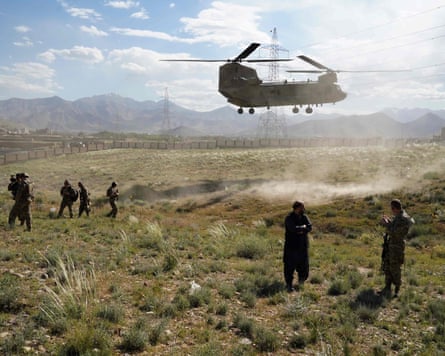 A US military Chinook helicopter lands on a field in Afghanistan in 2019. Photograph: Thomas Watkins/AFP/Getty Images
theguardian.com
A US military Chinook helicopter lands on a field in Afghanistan in 2019. Photograph: Thomas Watkins/AFP/Getty Images
theguardian.com
 Is Iran a ‘forever war’? – Stateside with Kai and Carter
theguardian.com
Is Iran a ‘forever war’? – Stateside with Kai and Carter
theguardian.com
Simon Tisdall argues in The Guardian that Washington is replaying Afghanistan’s basic pattern in Iran: a decision sold as limited and controllable that becomes self-perpetuating once the machinery of war is in motion.
He anchors the comparison in a few hard numbers. The Nato-backed campaign in Afghanistan, launched after the 11 September 2001 attacks, cost the lives of more than 2,400 US troops and 450 British troops, with civilian deaths in the tens of thousands and no definitive total. The US spent roughly $1 trillion and deployed more than 775,000 American service members, yet the Taliban returned to power in 2021, reimposing the kind of repressive Islamist rule the intervention was meant to prevent. Tisdall notes it is now five years since the chaotic retreat from Kabul — a political image that still shapes how leaders talk about “credibility” and “resolve”.
The piece’s central claim is less about battlefield tactics than about institutional memory. Carter Malkasian, a National War College professor and former civilian adviser to US forces in Helmand and Kabul, is quoted arguing that the premise for keeping troops in Afghanistan for 20 years was “fatally flawed” and that, over the past five years, not a single act of terrorism against the US was carried out by a group based in Afghanistan. The danger, he says, is collective forgetting: once costs are sunk and careers have been built around a mission, the easiest option is to keep going and redefine success.
Tisdall places Iran in that lineage. Trump, he writes, described the attack as a “little excursion”, but the war has entered its sixth month and has been escalating rapidly. The same rhetorical move appears: a promise of a quick operation that avoids the political liability of long occupation, paired with objectives that cannot be delivered by airstrikes alone. The Afghanistan experience also shows how quickly an initial counterterrorism rationale can expand into nation-building and regional remaking, as happened again in Iraq after 2003 — a war launched on claims about weapons and al‑Qaida links that later proved untrue.
The concrete details Tisdall uses to make the war feel present are not speeches but aftermath: he describes a woman walking past rubble in southern Tehran after Israeli and US airstrikes in April 2026. The strategic debate, in his telling, is conducted in abstractions while the physical destruction accumulates in specific neighbourhoods.
Afghanistan ended with a hurried evacuation and the return of the regime that was supposed to be displaced. Iran, six months in, is already being discussed in the language of endurance rather than exit.