
France says Gironde megafire contained
Var blaze reignites and forces evacuations, containment language spreads faster than firelines
Images
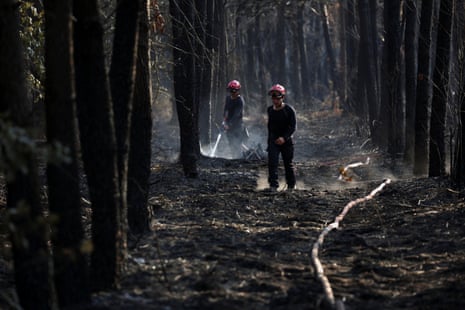 Firefighters work in Marcheprime, Gironde, south-west France, amid drought conditions following a heatwave and water shortages across much of the country. Photograph: Florion Goga/Reuters
theguardian.com
Firefighters work in Marcheprime, Gironde, south-west France, amid drought conditions following a heatwave and water shortages across much of the country. Photograph: Florion Goga/Reuters
theguardian.com
France’s interior minister said the “megafire” in Gironde has been contained after burning 42,000 hectares, as emergency services across southern Europe continue to juggle multiple blazes in Greece and Spain.
According to the Guardian’s Europe live coverage, Laurent Nuñez said the Gironde fire was no longer spreading, with firefighters describing the previous night as “mild” and weather conditions “slightly more favourable.” The containment claim arrives alongside reports that a separate fire in France’s Var area reignited after being brought under control, forcing nearly 2,500 people to evacuate as crews tried to re-establish containment lines.
The pattern is familiar: a single headline-grabbing blaze draws national attention, then the operational reality becomes a rolling series of flare-ups across different regions, each competing for aircraft, crews, and rest hours. In Greece, strong winds pushed fires in several areas including Boeotia, prompting evacuations by sea and emergency alerts for Attica around Athens and the nearby island of Evia, the Guardian reports. In Spain, fires continued in several regions including León and Zamora in the north-west and Castellón on the eastern coast, with some evacuation orders lifted as conditions improved.
Even when “stabilised” or “contained” appears in official language, the bill keeps running: evacuations, road closures, disrupted tourism and agriculture, and the long tail of cleanup and replanting. Authorities in Castellón were investigating suspected arson after finding two ignition points, a reminder that a summer fire season is not only a meteorological event but also a policing and prosecution problem. At the same time, the moment a fire is labelled criminal, the public expects prevention as well as response, while the physical reality still depends on wind shifts and fuel load.
The immediate political pressure tends to focus on visible assets—water-bombers, helicopters, national deployments—because they can be counted and filmed. But the operational bottleneck is often less dramatic: how quickly exhausted local services can rotate staff, how many simultaneous fronts can be defended, and how long a region can sustain evacuations before temporary shelter turns into a parallel welfare system.
Nuñez’s statement that Gironde is contained gives France a concrete milestone. The next test is whether containment holds when the weather stops being “slightly more favourable.”