
Trump says Hamas agrees to complete Gaza disarmament
Reuters reports Israel rejects terms as insufficient, phased plan collides with weapons control and ongoing strikes
Images
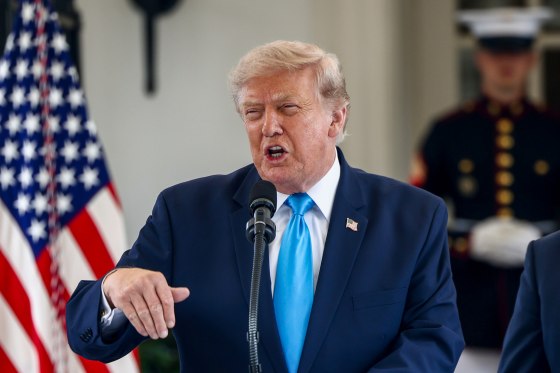 U.S. President Donald Trump
nbcnews.com
U.S. President Donald Trump
nbcnews.com
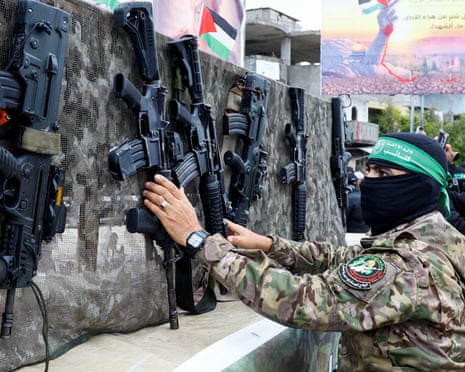 Hamas leaders have been holding talks with mediators from Egypt, Qatar and Turkey on the disarmament Trump’s Gaza plan, as presented to them by his Board of Peace, which oversees its implementation. Photograph: Hatem Khaled/Reuters
theguardian.com
Hamas leaders have been holding talks with mediators from Egypt, Qatar and Turkey on the disarmament Trump’s Gaza plan, as presented to them by his Board of Peace, which oversees its implementation. Photograph: Hatem Khaled/Reuters
theguardian.com
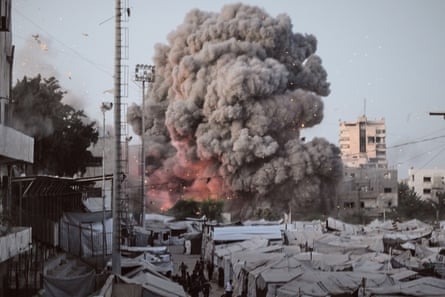 Smoke rises after an Israeli military strike in Gaza. Until now, the Israeli military has continued to expand its military occupation of Gaza, with Benjamin Netanyahu saying that Israel intends to expand the area under its control to 70% of the territory. Photograph: Jehad Alshrafi/AP
theguardian.com
Smoke rises after an Israeli military strike in Gaza. Until now, the Israeli military has continued to expand its military occupation of Gaza, with Benjamin Netanyahu saying that Israel intends to expand the area under its control to 70% of the territory. Photograph: Jehad Alshrafi/AP
theguardian.com
Donald Trump said talks in Cairo had produced what he called a “historic agreement” for the complete disarmament of Hamas in Gaza, describing it as a phased process tied to the creation of a new Palestinian governing authority. According to Reuters, there was no immediate public confirmation from either Hamas or Israel, and an Israeli official said the terms under discussion were not satisfactory. Israeli strikes continued in Gaza on the same day, with local medics reporting at least six Palestinians killed, including two children.
The announcement lands on the hardest part of any Gaza plan: translating paper commitments into physical control of weapons, territory, and checkpoints. Reuters reports that Hamas leaders have been speaking with mediators from Egypt, Qatar and Turkey, while a diplomat involved described a road map built around reciprocal steps rather than trust—an implicit admission that neither side expects the other to comply out of goodwill. The plan’s governing endpoint is phrased as “one authority, one law, one weapon,” with authority transferring in phases to a US-backed National Committee for the Administration of Gaza and an “international stabilisation force” meant to help maintain security.
But the sticking point is not rhetorical. An Israeli official told Reuters that Israel’s precondition is full demilitarisation: removal of weapons from Gaza and the complete elimination of Hamas’s military capacity. Reuters also reports that sources close to Hamas described a willingness to “confine and store” heavy weapons under a Palestinian body rather than hand them to Israel—an approach that preserves leverage while testing whether Israel will trade military pressure for political process. What happens to light weapons and personal arms remains unclear, as does the availability and mandate of any international force expected to police the transition.
The plan also competes with realities Israel is stating in public. Reuters notes Prime Minister Benjamin Netanyahu has said Israel intends to expand the area under its control to 70% of Gaza territory. That posture makes phased withdrawal a negotiation over timing and verification, not a simple concession, and it raises the question of who would physically dismantle tunnels, arms stockpiles and production facilities while Israeli forces remain active. Russia’s deputy ambassador to the UN, Anna Evstigneeva, told the Security Council that a road map prepared by Trump’s Board of Peace envoy had so far failed to gain support from both Israel and Hamas—suggesting the diplomatic traffic is heavy while the buy-in is thin.
Trump’s post described Israel getting “the security it deserves” and Gaza no longer serving as a base for attacks. Reuters’ reporting, however, shows the same day’s negotiations still hinged on definitions of “disarmament” that the parties do not share, while the war’s daily mechanics—airstrikes, territorial control, and the question of who carries a gun—remain unresolved.