
Apple and Amazon beat quarterly revenue expectations
Services and free cash flow drive post-earnings debate, AI infrastructure spending turns capex into the market’s main risk metric
Images
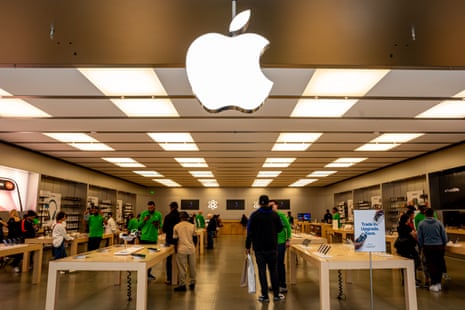 The Apple Store at Towson Town Center Mall in Maryland. Photograph: Andrew Harnik/Getty Images
theguardian.com
The Apple Store at Towson Town Center Mall in Maryland. Photograph: Andrew Harnik/Getty Images
theguardian.com
 Amazon’s fulfillment center in Robbinsville, New Jersey. Photograph: Eduardo Muñoz/Reuters
theguardian.com
Amazon’s fulfillment center in Robbinsville, New Jersey. Photograph: Eduardo Muñoz/Reuters
theguardian.com
Apple and Amazon beat revenue expectations in second quarter, investors focus on services softness and free cash flow, AI capex anxiety spreads beyond chipmakers
Apple reported quarterly revenue of $109.4bn and earnings per share of $2.02, while Amazon posted revenue of $200.6bn, according to The Guardian. Both companies exceeded Wall Street expectations, yet the market reaction was shaped less by top-line beats than by what investors are now treating as the real scorecard: how much cash is left after the infrastructure spending that the AI cycle is pulling into every corner of big tech.
For Apple, the immediate blemish was not iPhone or laptop demand but services. The Guardian reports that shares dipped slightly after earnings because revenue in the services division came in below market expectations. Apple’s relative calm in the current AI arms race has also become part of its appeal: the paper notes that Apple has benefited from a selloff in chip-linked names as investors look for a “safe haven” amid AI-driven volatility, with the stock up around 23% this year.
Amazon’s numbers carried the same split-screen dynamic. The company beat forecasts on advertising revenue and grew its AWS cloud business, The Guardian reports, but it also saw free cash flow decline. Even so, Amazon shares jumped more than 8% in after-hours trading, a reminder that in a market conditioned by years of cheap money, the direction of the cash-flow line can matter as much as the absolute level—especially when competitors are asking shareholders to bankroll multi-year buildouts whose payoffs are not yet priced.
Those competitors have been providing cautionary examples. The Guardian points to Tesla and Meta, whose shares fell after they disclosed large spending on AI infrastructure. The same anxiety has fed into a broader pullback in chip stocks such as Nvidia, as investor confidence has been tested both by the scale of planned data-centre investment and by advances in Chinese chip manufacturing.
Leadership transition added another layer of interpretation to Apple’s report. CEO Tim Cook told investors the call would be his final earnings presentation after 15 years, and Apple said he will be replaced by John Ternus, a longtime hardware engineering executive. The Guardian notes Apple’s market value expanded from roughly $350bn in 2011 to more than $5tn shortly before the call, a run built on disciplined product cycles and supply-chain execution rather than headline-grabbing bets.
The market is now asking whether the next era will reward restraint or spending. Apple and Amazon both showed they can still grow revenues at scale; the more contested question is how much of the AI boom will arrive as profit, and how much will be booked as capex and power bills.
Cook’s last earnings call ended with an iPhone-led revenue beat, while investors kept their attention on the line items that come after the revenue line.