
FCC bans new Chinese humanoid robots and power inverters
Trump administration frames connected hardware as supply-chain threat, datacentre buildout still needs someone’s equipment
Images
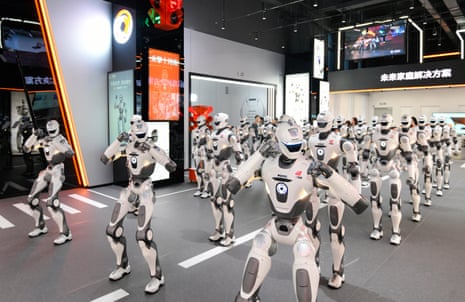 EngineAI T800 humanoid robots after rolling off the production line at a facility in Zhengzhou, Henan province, China, on 24 July 2026. Photograph: VCG/Getty Images
theguardian.com
EngineAI T800 humanoid robots after rolling off the production line at a facility in Zhengzhou, Henan province, China, on 24 July 2026. Photograph: VCG/Getty Images
theguardian.com
The US Federal Communications Commission has barred imports of new Chinese-made humanoid robots and connected power inverters, describing both as “unacceptable risks” to national security. According to the Guardian, the restrictions target “advanced robotic devices” including humanoid and animal-like quadrupeds, and extend to inverters used to connect renewables and batteries to the power grid and to datacentre equipment. The move aligns with the Trump administration’s wider push for “independent and secure supply chains” in what it calls critical and emerging technologies.
The ban lands at an awkward junction of two fast-moving trends: the growing use of connected machines in workplaces and homes, and the US buildout of datacentres that depend on stable electrical infrastructure. The FCC argues that robots equipped with sensors and network connections can collect data that could be exploited for surveillance, foreign intelligence, or remote commandeering. With power inverters, the worry is less about cameras and microphones than about a piece of equipment that sits quietly between generation, storage and consumption — and that can become a single point of failure when deployed at scale.
The stated scope matters. The Guardian reports the restrictions apply to robot and inverter models “that have not yet been released,” while the FCC retains authority to revoke authorizations for models already cleared for sale. That structure limits immediate disruption while keeping leverage over existing supply chains, and it gives regulators a tool to turn what looks like a product decision into a continuing compliance relationship.
The inverter portion also collides with market reality. China is described as the world’s largest maker of inverters, with companies such as Sungrow Power Supply and Huawei leading the market; both are already heavily sanctioned by the US. Datacentre construction has been “explosive,” the Guardian notes, and inverters are a basic input for both grid-connected renewables and backup-heavy computing facilities. When the government restricts a commodity-like component dominated by foreign suppliers, the cost typically reappears elsewhere: in procurement delays, in higher-priced substitutes, and in the quiet premium paid for “approved” vendors.
Beijing, for its part, was not offering an immediate on-the-record reply; the Chinese embassy in Washington did not respond to a request for comment, according to the Guardian. The political logic is clear enough without it: Washington is treating everyday industrial hardware as a strategic dependency, and writing that view into import rules.
The FCC’s announcement does not describe a single compromised robot or a sabotaged inverter. It describes a category of future products that will not be allowed onto the market in the first place.