
Haiti gang warfare shuts maternity clinics
MSF runs pop-up care in a deserted Port-au-Prince school, births shift to homes camps and streets
Images
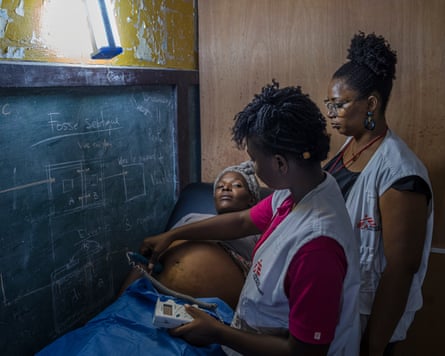 Françoise having a Doppler ultrasound in a clinic set up for a few hours inside a deserted school in Bel Air
theguardian.com
Françoise having a Doppler ultrasound in a clinic set up for a few hours inside a deserted school in Bel Air
theguardian.com
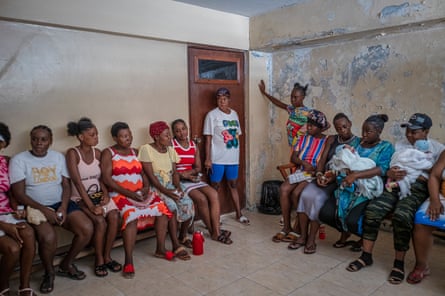 The clinic in the abandoned school in Bel Air is operated by Médecins Sans Frontières
theguardian.com
The clinic in the abandoned school in Bel Air is operated by Médecins Sans Frontières
theguardian.com
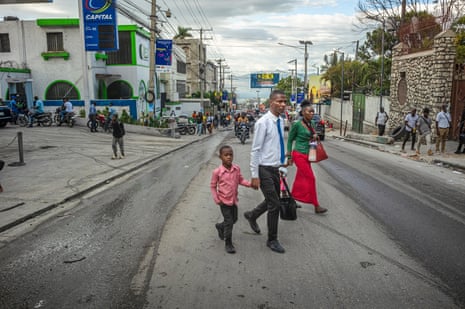 The government controlled Port-au-Prince district of Pétion-Ville
theguardian.com
The government controlled Port-au-Prince district of Pétion-Ville
theguardian.com
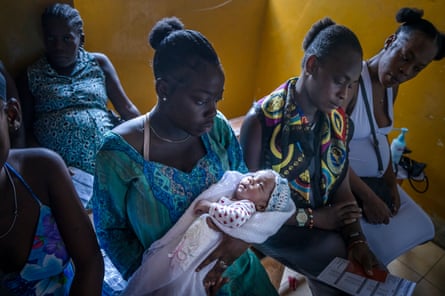 A month-old baby girl, Luguiona, in the arms of Ruth, a friend of the child’s mother, Adeline, at the Bel Air clinic
theguardian.com
A month-old baby girl, Luguiona, in the arms of Ruth, a friend of the child’s mother, Adeline, at the Bel Air clinic
theguardian.com
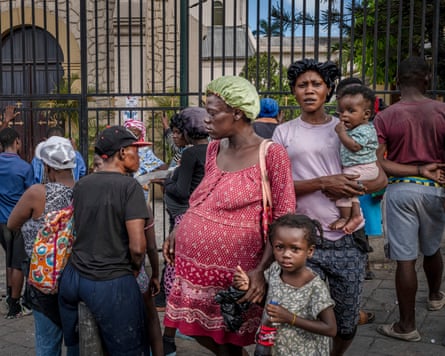 Residents in Pétion-Ville. About 1.4 million Haitians have become internally displaced and more than 6 million people are in need of urgent humanitarian assistance
theguardian.com
Residents in Pétion-Ville. About 1.4 million Haitians have become internally displaced and more than 6 million people are in need of urgent humanitarian assistance
theguardian.com
Fighting in Port-au-Prince has pushed maternity care into improvised rooms behind sandbags. In a photo essay for The Guardian, women queue at a pop-up clinic run by Médecins Sans Frontières in Bel Air, a hillside neighbourhood that has been controlled by gangs since a violent takeover in 2019. The clinic operates in a deserted school with boarded windows, battery-powered lamps and the expectation that gunfire can break out at any time.
The immediate story is obstetrics, but the mechanics are those of territorial control. A clinic in Cité Soleil, another gang-controlled area, has been forced to close, and only a fraction of maternity services in the capital remain operational, according to the report. When the safest place to deliver a baby is a temporary consultation room in a shuttered school, the “health system” becomes a set of moving targets: staff, supplies and patients all ration risk as much as medicine.
The numbers behind that rationing are blunt. MSF says maternal deaths in hospitals rose between February 2022 and April 2025, from 250 to 350 per 100,000 live births. The Guardian cites an estimate that roughly 60% of births in Port-au-Prince now happen without medical care — at home, in camps or on the street — leaving complications such as haemorrhage, infection and hypertension untreated. One patient in Tabarre, a neighbourhood also mentioned in the essay, is treated for a gunshot wound; the boundary between emergency medicine and routine care has dissolved.
International aid politics sits inside the same frame. Human Rights Watch is quoted saying the Trump administration’s suspension of USAID funding in 2025 deprived about 750,000 women and girls in Haiti of access to healthcare. In practice that means fewer fixed facilities with predictable hours, and more reliance on organisations that can operate under threat, pull out quickly, and still attract donor money.
The wider humanitarian picture is now measured in displacement and scarcity. The Guardian reports about 1.4 million Haitians internally displaced and more than 6 million in need of urgent humanitarian assistance, with more than half the population facing high levels of food insecurity. The essay’s scenes — a dim room, a line that starts early, prenatal exams behind a screen — are the retail end of those totals.
In Bel Air, Françoise, eight months pregnant and described as having a condition that increases the risk of eclampsia, arrives early because she does not know where else she could go. The clinic is temporary by design, and the neighbourhood around it is controlled by men with rifles.