
Russia and North Korea near first road bridge link
Satellite imagery shows Tumen River crossing largely complete, trade and tourism pitch collides with logistics war logic
Images
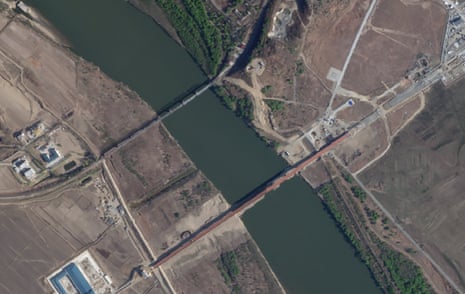 Satellite imagery from April 2026 shows a newly built bridge that forms the first ever road crossing between North Korea and Russia. Above it is the Friendship bridge, the only rail crossing between the two countries. Photograph: Truth Hounds / Planet Labs PBC
theguardian.com
Satellite imagery from April 2026 shows a newly built bridge that forms the first ever road crossing between North Korea and Russia. Above it is the Friendship bridge, the only rail crossing between the two countries. Photograph: Truth Hounds / Planet Labs PBC
theguardian.com
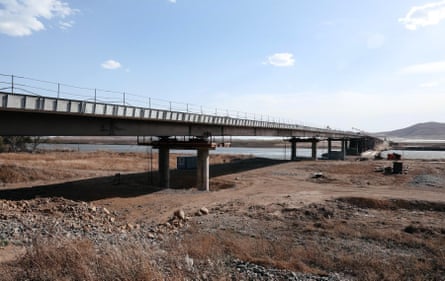 A newly built bridge that spans the Tumen River, forming the first ever road crossing between North Korea and Russia. Photograph: Ministry of Transport of the Russian Federation
theguardian.com
A newly built bridge that spans the Tumen River, forming the first ever road crossing between North Korea and Russia. Photograph: Ministry of Transport of the Russian Federation
theguardian.com
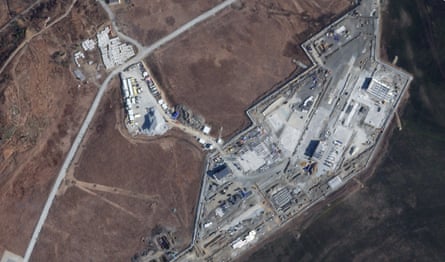 Satellite imagery from April 2026 shows construction under way on a border checkpoint on the Russian side of the only road bridge connecting Russia and North Korea. New buildings and building materials are visible on site. The checkpoint, reported to be 40% complete as of April, is planned to be 10 lanes wide. Photograph: Truth Hounds / Planet Labs PBC
theguardian.com
Satellite imagery from April 2026 shows construction under way on a border checkpoint on the Russian side of the only road bridge connecting Russia and North Korea. New buildings and building materials are visible on site. The checkpoint, reported to be 40% complete as of April, is planned to be 10 lanes wide. Photograph: Truth Hounds / Planet Labs PBC
theguardian.com
A new road bridge across the Tumen River between Russia and North Korea is largely complete, according to satellite imagery cited by The Guardian, creating the first ever road crossing between the two countries. The span links Khasan in Russia’s far east with Tumangang in North Korea, running near the existing Friendship Bridge rail crossing that has long been the only fixed link.
Russian and North Korean officials have described the project as a way to expand trade and tourism, with Russia’s transport minister Andrey Nikitin saying it would “optimize logistics” and develop border areas economically, and North Korea’s KCNA promising more travel and commodity circulation. But a Ukrainian human rights group, Truth Hounds, argues the bridge’s practical value lies elsewhere: moving military supplies in ways that are harder to track than rail shipments. Its open-source researchers say trucks can be loaded and unloaded faster than trains, can be dispatched from many points rather than fixed rail hubs, and look broadly similar from above, while railcars can sit exposed during satellite passes and sometimes reveal cargo type.
The Guardian reports Truth Hounds also questions the commercial case for the crossing. The bridge is estimated in the reporting to have cost more than $100 million, while bilateral trade was reported at $34 million in 2024. Tourism from Russia into North Korea remains tightly controlled and typically limited to escorted visits, leaving limited obvious demand for a new road gateway designed to handle routine cross-border traffic.
The timing matters because Russia’s war logistics have become a target set in their own right. A road crossing gives Moscow another channel for moving matériel that does not depend on a small number of rail chokepoints, even if trucks still require roads, fuel, drivers, and border procedures. Truth Hounds’ argument is that the “shape” of the infrastructure—road rather than rail—fits a world where monitoring is persistent but not continuous, and where the most useful shipments are those that blend into ordinary-looking transport.
North Korea has already finished its side of the project, including customs and quarantine facilities, ahead of a planned opening date reported as 19 June 2026. Russia, according to the same reporting, has fallen behind on its side of the crossing, and no new opening date has been confirmed.
The bridge sits in a remote corner of the Russian Far East, but it is built to carry ordinary vehicles rather than trains. The only existing crossing in the area still runs on rails above it.