
US pauses strikes on Iran for second night
Commanders cite dwindling munitions and exhausted target list, Hormuz talks continue while options stay on the table
Images
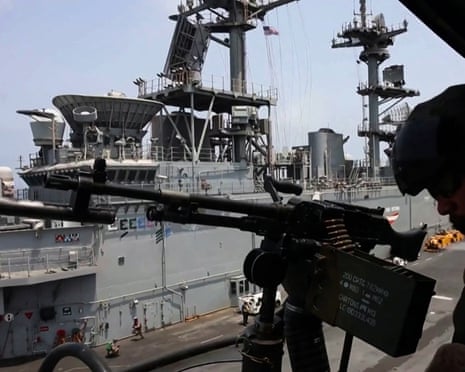 US naval forces carry out an operation as part of their blockade on Iranian ports and ships. Photograph: US Central Command/AFP/Getty Images
theguardian.com
US naval forces carry out an operation as part of their blockade on Iranian ports and ships. Photograph: US Central Command/AFP/Getty Images
theguardian.com
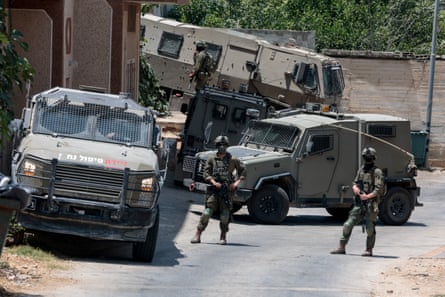 Israeli army units stage a raid near Nablus in the occupied West Bank after the deaths of four Palestinians and two Israelis when armed settlers entered a village. Photograph: Mohammed Torokman/Reuters
theguardian.com
Israeli army units stage a raid near Nablus in the occupied West Bank after the deaths of four Palestinians and two Israelis when armed settlers entered a village. Photograph: Mohammed Torokman/Reuters
theguardian.com
The United States has paused strikes on Iran for a second night after senior military officials advised President Donald Trump to halt the bombing campaign, as diplomatic contacts continue over reopening the Strait of Hormuz. The Guardian reports that the lull began on Friday evening after nearly two weeks of US strikes and the collapse of a ceasefire brokered by Trump. Iran, for its part, said it had also paused what it called retaliatory attacks against US allies in the region.
According to the report, US officials warned the president about dwindling munitions stockpiles and the limited returns from continuing the campaign. Axios cited Admiral Bradley Cooper, the top US military commander in the region, as telling Trump that the operation had reached the limits of its effectiveness and that the US had nearly exhausted its target list inside Iran. In the Oval Office, the Guardian says, Vice President JD Vance and Dan Caine, the chair of the Joint Chiefs of Staff, raised the risks of renewed major combat operations, after which Trump ordered the military to call off new strikes.
The pause is being framed publicly as a choice between diplomacy and escalation, but the mechanics described are closer to an inventory problem. Air campaigns depend not only on political will but on stockpiles, target development, and the ability to sustain tempo without degrading readiness elsewhere. When commanders tell the White House that the list of worthwhile targets is running out, the question becomes what the next strike would actually buy — and what it would cost in munitions that cannot be quickly replaced.
Meanwhile, the strategic choke point remains maritime. Washington has blamed Iran for closing the Strait of Hormuz, a conduit for an estimated 20% of the world’s oil and gas, and senior diplomats from Iran and Oman were reportedly holding talks aimed at reopening it. The Guardian reports that Tehran has demanded payment and control over which ships pass through the strait — a demand that turns a global commons into a toll booth, and forces shipping and energy markets to price not just military risk but administrative discretion.
Israel’s government is also part of the timetable. Prime minister Benjamin Netanyahu is expected to visit the White House on Tuesday and is described as a vocal critic of US negotiations with Iranian leaders. The Guardian notes he faces political pressure to show results from campaigns against Iran and Hezbollah in Lebanon ahead of elections scheduled for October, creating a domestic incentive to keep the conflict legible as progress rather than as managed de-escalation.
Trump’s UN ambassador, Mike Waltz, said on NBC that the president was keeping all options on the table and not ruling out additional strikes. For now, the most concrete development is that the bombing has stopped — not because the conflict has been resolved, but because the people tasked with running it told the president it was no longer producing new outcomes.
The negotiations described are taking place while tankers wait on a narrow waterway. The pause has lasted two nights.