
Typhoon Noul forces mass evacuations in southern China
Guangdong relocations top 700000 as flights and trains halt, scaffolding collapse and injuries expose everyday weak points
Images
 Typhoon Noul has caused widespread damage in southern China, including in Hong Kong. Photograph: Venron Yuen/Nexpher/ZUMA Press Wire/Shutterstock
theguardian.com
Typhoon Noul has caused widespread damage in southern China, including in Hong Kong. Photograph: Venron Yuen/Nexpher/ZUMA Press Wire/Shutterstock
theguardian.com
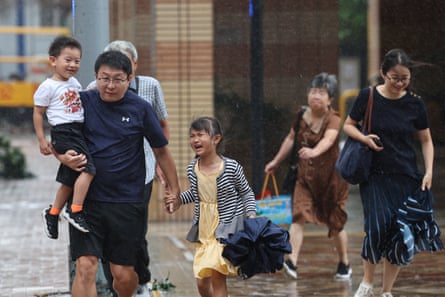 People brave the heavy wind and rain as they cross a street in Hong Kong. Photograph: Tyrone Siu/Reuters
theguardian.com
People brave the heavy wind and rain as they cross a street in Hong Kong. Photograph: Tyrone Siu/Reuters
theguardian.com
 Passersby walk in Hong Kong's Mong Kok district under heavy rain and wind ahead of Typhoon Noul on Saturday, July 25, 2026. (AP Photo/Chan Ho-him) (AP)
Chan Ho-him) (AP)
Passersby walk in Hong Kong's Mong Kok district under heavy rain and wind ahead of Typhoon Noul on Saturday, July 25, 2026. (AP Photo/Chan Ho-him) (AP)
Chan Ho-him) (AP)
More than 715,000 people were ordered from their homes in China’s Guangdong province as Typhoon Noul made landfall early Sunday, bringing heavy rain and strong winds to the southern coast and neighboring Hong Kong. According to The Guardian, hundreds of flights were cancelled and train services in Guangdong were halted, while Hong Kong reported injuries during the storm period.
The evacuation figures underline how disaster response in southern China has become a mass-mobilisation exercise that repeats several times each summer. The Independent, citing state media, put the number relocated in Guangdong at more than 340,000 by Saturday afternoon; The Guardian reported a higher total of more than 715,000 evacuated as the typhoon hit and then moved inland. Authorities declared the highest alert for flash floods in several provinces and urged local governments to focus on flood-prone terrain—mountains, rivers, valleys, bridges and construction sites—areas where enforcement tends to be episodic until a storm makes it politically unavoidable.
The economic disruption is immediate and measurable. Hong Kong airport’s website showed widespread cancellations, and The Guardian said about 350 flights were called off on Sunday alone, with services expected to resume gradually later in the day. When mobile networks, transport links and airports pause, the costs land first on households and small businesses that rely on daily cashflow, while the state’s visible contribution is the ability to move large numbers of people quickly and to stop traffic on command.
The typhoon also produced the kind of urban incident that rarely features in preparedness plans: as Noul approached, part of a large scaffolding on a high-rise building collapsed in Hong Kong. Police initially reported no injuries from the collapse, but The Guardian later said at least nine people were injured in Hong Kong during the typhoon period. Such episodes sit in the gap between weather forecasting and building-site discipline, where responsibility is dispersed across contractors, inspectors and property owners until a storm turns it into a public order problem.
Noul is the latest in a run of storms this month. Earlier in July, Typhoon Bavi triggered evacuations in eastern China, and another typhoon, Maysak, made landfall in southern China, according to both outlets. Each event tests the same logistics—transport shutdowns, temporary housing, and the capacity to keep supply chains moving—while the longer-term bill is paid in repairs, lost workdays and higher insurance and construction costs.
By Sunday, forecasters expected Noul to weaken as it moved inland, but the rain bands were still projected to push across southern provinces into the week. The airport cancellations and the emptying of neighborhoods were already on the record.