
Trump wears Trump 2028 hat at White House Correspondents’ Dinner
Rescheduled gala follows security-checkpoint shooting, press awards share stage with president suing journalists
Images
 Donald Trump speaks at the White House correspondents dinner at the Waldorf Astoria in Washington DC. Photograph: Mark Schiefelbein/AP
theguardian.com
Donald Trump speaks at the White House correspondents dinner at the Waldorf Astoria in Washington DC. Photograph: Mark Schiefelbein/AP
theguardian.com
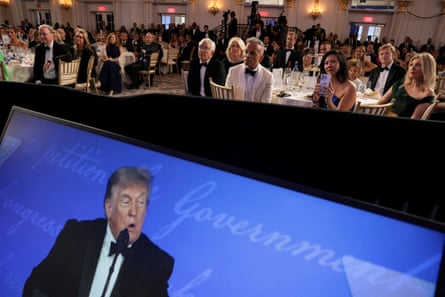 The room of journalists watches as Donald Trump delivers his speech. Photograph: Jonathan Ernst/Reuters
theguardian.com
The room of journalists watches as Donald Trump delivers his speech. Photograph: Jonathan Ernst/Reuters
theguardian.com
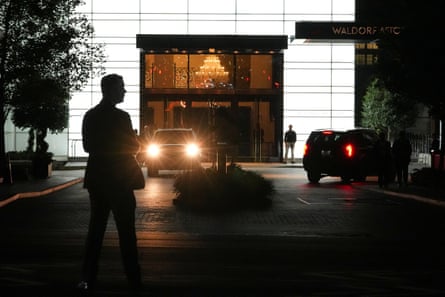 US Secret Service personnel outside the venue during the dinner at the Waldorf Astoria. Photograph: Nathan Howard/Reuters
theguardian.com
US Secret Service personnel outside the venue during the dinner at the Waldorf Astoria. Photograph: Nathan Howard/Reuters
theguardian.com
Donald Trump ended the White House Correspondents’ Dinner by placing a red “Trump 2028” hat on his head, after an hour-long speech at the Waldorf Astoria in Washington. The dinner had been rescheduled after the original April event was canceled following a shooting at a security checkpoint outside the ballroom, according to The Guardian. In the room were reporters who had just been honored for stories scrutinizing Trump’s administration, including a Wall Street Journal team he is suing.
The correspondents’ dinner is marketed as a celebration of press freedom, but in practice it is one of the few nights when the White House and the press corps share a stage and an incentive to look convivial. Trump used that stage to cycle between praise and contempt: calling journalism “fake news,” then telling the audience it does “an amazing job,” then returning to taunts aimed at specific figures. The targets ranged from political opponents to journalists, including CNN’s Kaitlan Collins, who had been honored earlier in the evening for her White House coverage, the Times reports.
The mechanics of the speech mattered as much as its content. Trump’s jabs at Adam Schiff and jokes about Chris Christie and Jerry Nadler were not policy arguments; they were reminders that attention can be directed and reputations can be made smaller in a single line. When a term-limits joke fell flat, Trump broke the fourth wall—asking whether anyone understood “this whole freakin stupid speech that they wrote”—turning the evening into a performance of dominance over the script itself. In the same sequence, he briefly touched the war with Iran, telling the room it was going “extremely well,” before pivoting back to the press: “Don’t believe the fake news.”
The dinner’s structure also placed two institutions with conflicting interests in the same photograph. The White House benefits when the press is seen as another tribe at the gala, trading banter and awards; journalists benefit from access, proximity, and the appearance of being in the room where history happens. Trump’s approach exploits that arrangement by recasting criticism as proof of bias, while using the invitation itself as evidence that the relationship is not adversarial but transactional.
The night’s oddest juxtaposition was that the awards honored reporting that had caused Trump legal and political trouble, while the president used the same event to ridicule the profession that produced it. The Wall Street Journal team recognized on stage was cited for a story alleging Trump sent a “bawdy” letter to Jeffrey Epstein in 2003—reporting Trump has challenged in court, according to The Guardian.
At a dinner meant to signal institutional confidence after a security scare, the most visible souvenir was a campaign hat for an election that has not begun.