
West Bank shooting kills four Palestinians and one Israeli
Incident in Tell near Nablus sparks calls by Netanyahu and Israel Katz for troop surge and home razings, work permits become a punishment tool before facts settle
Images
 People in mourning at a hospital in Nablus, where the four Palestinian bodies were taken. Israel’s rescue service reported that an Israeli man in his 30s was also killed in the incident. Photograph: Majdi Mohammed/AP
theguardian.com
People in mourning at a hospital in Nablus, where the four Palestinian bodies were taken. Israel’s rescue service reported that an Israeli man in his 30s was also killed in the incident. Photograph: Majdi Mohammed/AP
theguardian.com
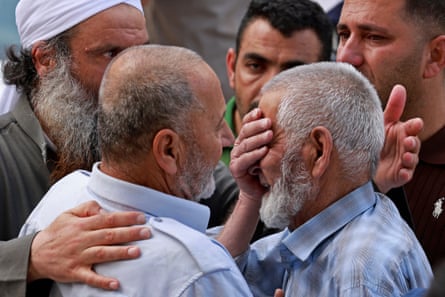 Family members of one of the four Palestinians who died in the clashes mourn outside a hospital in Nablus, in the occupied West Bank. Photograph: Jaafar Ashtiyeh/AFP/Getty
theguardian.com
Family members of one of the four Palestinians who died in the clashes mourn outside a hospital in Nablus, in the occupied West Bank. Photograph: Jaafar Ashtiyeh/AFP/Getty
theguardian.com
Four Palestinians and one Israeli were killed in a shooting in the northern West Bank village of Tell near Nablus, according to the Palestinian health ministry and Israel’s military. The Guardian reports that residents described the incident as a settler attack in which Israeli forces were also present, while the Israeli military said troops arrived after reports of an attack on Israeli civilians hiking near the Havat Gilad settlement. Several others were reported seriously injured. Israel identified the Israeli dead as Benayahu Mellet, 32, from Havat Gilad.
Accounts of how the violence began diverged immediately, but the official responses converged on escalation. Walid Zidan, head of Tell’s village council, told the Guardian that about 20 settlers entered the village early in the morning and were soon joined by soldiers, after which shots were fired during clashes as villagers tried to defend homes and property. The Israeli military said attackers seized a weapon from a member of the security forces and opened fire. The Palestinian health ministry in Ramallah said the four Palestinians were killed by Israeli forces; the Guardian reports they were from the same family.
By midday, the incident had already become a rationale for broader measures. The Israeli military announced preparations for an “extensive counterterror operation” in the West Bank and surrounded Nablus, according to the report. Prime Minister Benjamin Netanyahu and defence minister Israel Katz called for more troops to be deployed. They also urged punitive steps focused on Tell: razing the homes of the accused, collecting weapons, and revoking work permits.
Those measures map onto how the West Bank’s security economy now functions: collective restrictions are administratively easy to impose, and they shift costs onto people who are not charged with any crime. Work permits are not only a livelihood tool but also a compliance lever; revoking them can punish a village faster than any investigation can identify individual shooters. Demolitions, similarly, are visible and immediate, and they do not require a court to prove intent beyond dispute.
The rhetoric around Tell suggests the space for de-escalation is shrinking. The Guardian reports that settlers called for attacks to “erase” the village, and that finance minister Bezalel Smotrich said Tell and other villages “need to look exactly like the refugee camps in Nablus and Tulkarm.” Online video cited in the report showed people appearing to be Palestinians shot and lying on the ground, while the Palestinian foreign ministry condemned what it called a massacre committed by settlers “in partnership” with occupation forces.
The shooting leaves a concrete trail of decisions: troops moved to surround Nablus, and Israeli leaders publicly tied the next steps to demolitions, weapons sweeps, and the cancellation of permits in a single named village.