
Trump administration imposes new tariffs on more than 80 countries
Section 301 forced-labor rationale replaces expiring global duty, trade policy keeps shifting to fit presidential authority
Images
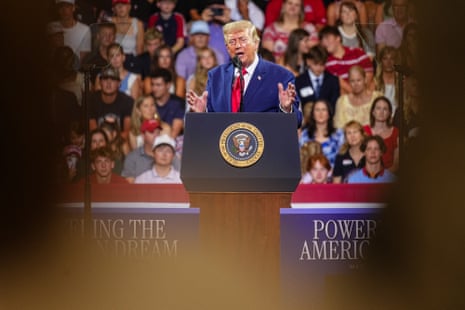 Trump speaks at a rally in Marietta, Georgia, on Wednesday. Photograph: Bloomberg/Getty Images
theguardian.com
Trump speaks at a rally in Marietta, Georgia, on Wednesday. Photograph: Bloomberg/Getty Images
theguardian.com
US President Donald Trump’s administration is imposing a fresh wave of tariffs on imports from more than 80 countries, according to The Guardian. The duties—set between 10% and 12.5%—are due to take effect at 12:01 a.m. Friday, replacing a blanket 10% global tariff that was about to expire.
The legal story is doing as much work as the economic one. The February tariff regime was introduced after the US Supreme Court ruled that many of Trump’s earlier tariffs were illegal, and it was explicitly time-limited. With the deadline approaching, the administration is now shifting the justification again—this time invoking Section 301 of the Trade Act of 1974, a tool historically associated with investigations into unfair trade practices and, in this iteration, framed around forced labor.
The list of targets is broad—covering the United Kingdom, Mexico, Canada, Australia, India, China and the European Union’s member states—suggesting a policy built for leverage rather than for isolating a particular supply chain. Jamieson Greer, the US trade representative, said the tariffs are meant to correct “human rights abuses” and “distortive trade practices,” while also praising partners for adopting forced-labor import prohibitions. That combination—penalties paired with compliments—reads like an attempt to keep the tariff threat available even when counterparties move in the direction Washington demands.
Canada’s response points to the diplomatic problem: when the instrument is applied to allies as well as adversaries, the stated rationale quickly becomes a dispute over who gets exempted rather than how forced labor is policed. Canada said it should not be targeted and described itself as a leader in blocking forced-labor goods. The Canadian Chamber of Commerce’s Matthew Holmes argued for a coordinated multilateral approach and questioned the timing, noting that the previous tariffs were expiring.
In the background sits a constitutional constraint that keeps resurfacing. Alan Wolff of the Peterson Institute for International Economics wrote that the Section 301 move raises questions about presidential authority, because the Constitution vests tariff power in Congress and Congress has not clearly delegated such sweeping discretion. The administration’s repeated re-basing of tariffs onto different statutes—after the Supreme Court’s 6–3 ruling that peacetime tariff authority belongs to Congress—has turned trade policy into a rolling exercise in finding the next viable hook.
The new tariff regime is also explicitly temporary, limited to 150 days. At 12:01 a.m. Friday, the world’s largest consumer market will again be charging a surcharge at the border—this time under a forced-labor banner—on imports from countries that include some of its closest trading partners.