
Wildfires force mass evacuations in France and Spain
Blazes near Bordeaux and around Madrid draw military and air support, peak holiday season turns forest edges into logistics tests
Images
 Firefighters battle the blaze using a water truck near the village of Le Porge in south-western France. Photograph: Romain Perrocheau/AFP/Getty
theguardian.com
Firefighters battle the blaze using a water truck near the village of Le Porge in south-western France. Photograph: Romain Perrocheau/AFP/Getty
theguardian.com
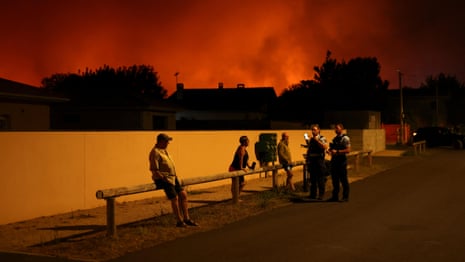 Thousands evacuated in south of France as wildfire rages across pine forest – video
theguardian.com
Thousands evacuated in south of France as wildfire rages across pine forest – video
theguardian.com
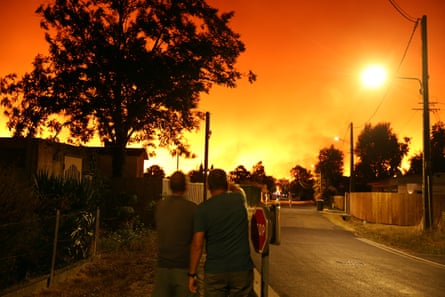 People look at the sky illuminated by wildfires in Le Porge, south-west France, on Thursday. Photograph: Romain Perrocheau/AFP/Getty
theguardian.com
People look at the sky illuminated by wildfires in Le Porge, south-west France, on Thursday. Photograph: Romain Perrocheau/AFP/Getty
theguardian.com
 A man rests with his dog in a community hall on a camp bed in Le Porge. Photograph: Romain Perrocheau/AFP/Getty
theguardian.com
A man rests with his dog in a community hall on a camp bed in Le Porge. Photograph: Romain Perrocheau/AFP/Getty
theguardian.com
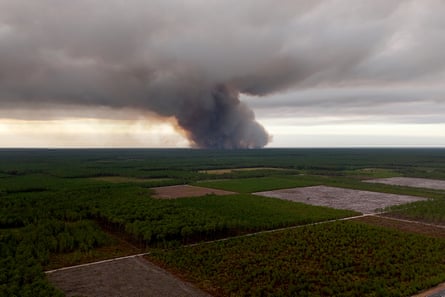 Smoke rising from the wildfire in Saumos is photographed from Arès on Wednesday. Photograph: Romain Perrocheau/AFP/Getty
theguardian.com
Smoke rising from the wildfire in Saumos is photographed from Arès on Wednesday. Photograph: Romain Perrocheau/AFP/Getty
theguardian.com
More than 18,800 people were evacuated from France’s southwestern Atlantic coast as a fast-moving wildfire tore through pine forest near the village of Le Porge, while Spain declared a national emergency in the Madrid region and in Ávila province amid multiple blazes, The Guardian reports. In France, the fire burned more than 3,700 hectares in roughly a day; officials said no casualties were reported, but several houses were destroyed.
French authorities deployed hundreds of firefighters, water trucks and water-bombing aircraft, with the Gironde prefecture describing conditions as still unfavourable and the fire not yet stabilised. A regional fire service chief told reporters the blaze was erratic and one main front was close to a semi-urban area — a familiar problem in coastal holiday zones where forests, campsites and housing sit interlocked. Evacuations in peak season also expose a quieter dependency: civil protection budgets and staffing models built for “normal” summers now face repeated surges.
In Spain, around 10,000 people were evacuated around the Madrid region as fires burned out of control. The government deployed a military emergency unit, and Prime Minister Pedro Sánchez said every available resource was being used in several affected areas. The Guardian cites data showing almost 125,000 hectares have burned in Spain so far this year, compared with 393,000 hectares in all of last year — a comparison that makes the calendar as important as the weather.
The heat backdrop is not limited to land. The Guardian also points to a marine heatwave affecting much of the Mediterranean, with monitoring data showing sea-surface temperatures in some areas far above the 1991–2020 average. Warmer seas can load the atmosphere with moisture and energy, complicating forecasts and stretching the firefighting season on both ends.
Across the EU, the report says the area burned by this point in the year is about twice the average of the last two decades, and that France and Spain have broken records both for area burned and number of fires. Those are the kinds of benchmarks that turn emergency response into infrastructure: aircraft fleets, trained crews, fuel logistics, evacuation routes, and insurance coverage that has to be priced before the next ignition.
Near Le Porge, officials were still describing the fire as not stabilised. The most concrete measure of Europe’s summer risk was not a temperature reading but a line of cars leaving campsites and holiday homes.