
Drone strikes hit Iraq oil sites near Basra
Foreign energy staff evacuate as militias operate beyond Baghdad control, sovereignty becomes a press release during regional escalation
Images
 An oil tanker burns after being hit by an Iranian strike at Khor Al Zubair port near Basra, Iraq, on 11 March. Photograph: AP
theguardian.com
An oil tanker burns after being hit by an Iranian strike at Khor Al Zubair port near Basra, Iraq, on 11 March. Photograph: AP
theguardian.com
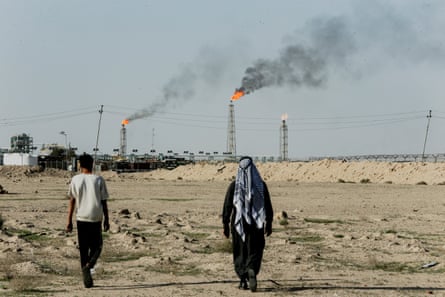 People walk near farmland by the Zubair oil field near Basra, Iraq. Photograph: Essam Al-Sudani/Reuters
theguardian.com
People walk near farmland by the Zubair oil field near Basra, Iraq. Photograph: Essam Al-Sudani/Reuters
theguardian.com
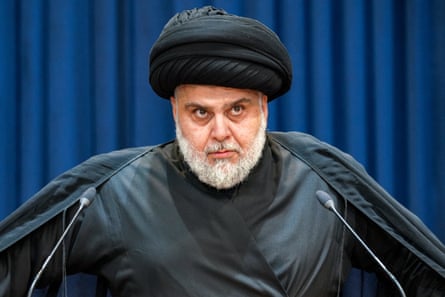 Moqtada al-Sadr. Photograph: Qassem Al-Kaabi/AFP/Getty Images
theguardian.com
Moqtada al-Sadr. Photograph: Qassem Al-Kaabi/AFP/Getty Images
theguardian.com
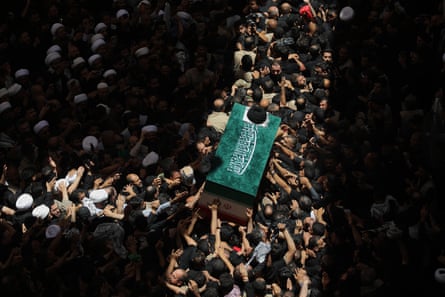 The coffin of the late Iranian supreme lleader Ayatollah Ali Khamenei is carried by mourners to the Imam Ali Shrine in Najaf, Iraq, on 8 July. Photograph: Anmar Khalil/AP
theguardian.com
The coffin of the late Iranian supreme lleader Ayatollah Ali Khamenei is carried by mourners to the Imam Ali Shrine in Najaf, Iraq, on 8 July. Photograph: Anmar Khalil/AP
theguardian.com
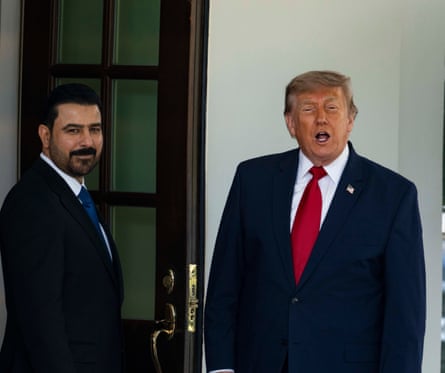 Ali al-Zaidi meets Donald Trump at the White House on 14 July. Photograph: Andrew Thomas/CNP/Shutterstock
theguardian.com
Ali al-Zaidi meets Donald Trump at the White House on 14 July. Photograph: Andrew Thomas/CNP/Shutterstock
theguardian.com
An Iranian strike hit and burned an oil tanker at Khor Al Zubair port near Basra earlier this year, one of a series of attacks that pushed foreign energy staff out of southern Iraq and exposed how little control Baghdad has over the country’s most valuable infrastructure. In a long report, The Guardian describes drones flying over Basra and targeting an oilfield operated by BP, a cargo terminal at Basra airport, and a compound housing foreign oil service companies. Another attack on the same compound damaged offices and warehouses used by Halliburton and KBR, the paper reports.
The pattern matters because Iraq’s oil economy is not just a revenue stream; it is the country’s substitute for political cohesion. When drones can reach oilfields, airports and logistics compounds, the immediate cost is measured in fires and evacuations, but the longer cost is a shift in who can credibly promise security. The Guardian reports that hundreds of energy workers from American, European and Chinese firms left Iraq, many travelling overland due to closed airspace, while thousands of Iraqi energy workers were sent home. A shutdown that begins as a security measure quickly becomes a bargaining chip in contract negotiations, local patronage networks and militia financing.
The Guardian describes most attacks as being carried out by Iraqis on Iraqi soil, pointing to factions of Iran-backed Shia militias. Officials cited in the report said the strikes were conducted by the Islamic Resistance in Iraq, an umbrella of paramilitary groups trained and equipped by Iran after 2003 and linked to the Popular Mobilisation Units. The PMU is theoretically subordinate to the Iraqi government, but The Guardian reports it operates with its own agenda and an economic footprint through investments—an arrangement that blurs the line between state payroll and private force.
In that environment, “sovereignty” becomes a press release. The Guardian says central and local authorities issued statements about investigations, while the attacks continued and the energy sector thinned out. One senior official at the Basra oil ministry called the strikes an act of treason, but the report’s detail is less about rhetoric than about capacity: the state can name the problem, yet it cannot stop the drones.
The report situates the violence in the collapse of a long-running regional equilibrium. For decades, the US, Iran and Israel maintained a tense balance that avoided full-scale confrontation; The Guardian argues that the balance ended suddenly, leaving Iraq as the accessible terrain where rivals can impose costs without formally opening new fronts. The result is a country that hosts foreign operators, foreign capital and foreign strategic aims, while relying on armed groups it does not fully command to keep order.
The Guardian’s account includes a fire visible at night after the 6 March strike on the compound used by oil service companies. In Basra, the lights that matter most are still the ones from burning fuel.