
Andy Burnham wins early European goodwill
UK domestic agenda echoes EU strategic autonomy push, Brexit red lines still fence off big bargains
Images
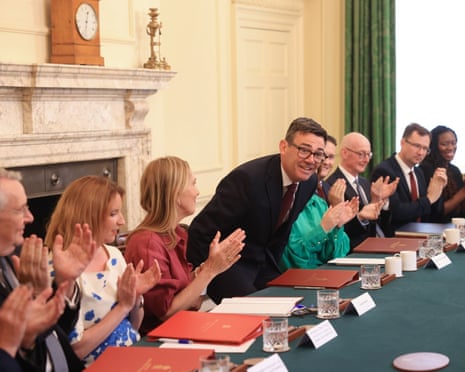 Andy Burnham’s first cabinet meeting in Downing Street, London, 21 July 2026. Photograph: Chris Ratcliffe/EPA
theguardian.com
Andy Burnham’s first cabinet meeting in Downing Street, London, 21 July 2026. Photograph: Chris Ratcliffe/EPA
theguardian.com
 Rafael Behr
theguardian.com
Rafael Behr
theguardian.com
 Andy Burnham appears more sympathetic towards the EU than Keir Starmer. Photograph: WPA/Getty Images
theguardian.com
Andy Burnham appears more sympathetic towards the EU than Keir Starmer. Photograph: WPA/Getty Images
theguardian.com
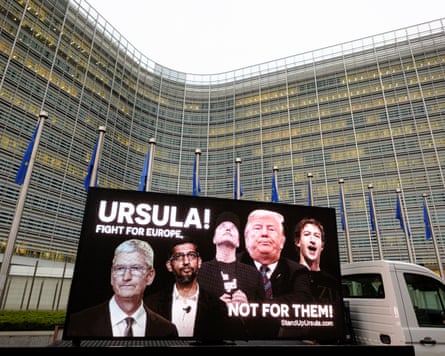 The EU is pushing back against the prevalence of US big tech. Photograph: Thierry Monasse/Getty Images
theguardian.com
The EU is pushing back against the prevalence of US big tech. Photograph: Thierry Monasse/Getty Images
theguardian.com
Andy Burnham walked into Downing Street this week with European leaders already writing their welcome notes. According to the Guardian, European Commission president Ursula von der Leyen said she looked forward to “strengthening cross-Channel ties”, while France’s Emmanuel Macron and Germany’s Friedrich Merz signalled hopes for a closer partnership.
The choreography matters because Britain has cycled through prime ministers since the Brexit vote, and the EU’s default posture has been to wait out London’s next turn of the wheel. Burnham arrives branded as a domestic reformer — the “King of the North” in British political shorthand — but his agenda sits in the same policy neighbourhood as Brussels’s current preoccupations: industrial capacity, energy security, and less dependence on US technology platforms. Jon Henley reports that Labour’s existing “red lines” still rule out the single market, a customs union and freedom of movement, leaving little room for the grand reconciliation that Brexit’s critics still daydream about. What is left is the quieter work of harmonising priorities: security cooperation, friction reduction at borders, and joint approaches to things like critical minerals and cloud storage.
That is also where the politics inside Britain starts to look like foreign policy by other means. Burnham has been careful about the symbolic traps of reopening the referendum argument. Henley notes that while campaigning in a heavily Leave-voting constituency he called Brexit “damaging” but said the country should not “rerun the Brexit arguments”, and ruled out rejoining at the time. The constraint is not just public fatigue; it is parliamentary arithmetic and party management. Rafael Behr describes a Labour culture that has watched leaders rise and fall on media cycles and factional ambushes, and that now prizes a politician who looks as if he enjoys the mechanics of politics rather than tolerating them.
Behr’s portrait of Burnham is less about ideology than about competence as a performance art: planning, campaigning, and speaking in a way that signals purpose. He contrasts that with Keir Starmer’s reputation among colleagues as a leader who delegated political organisation and treated a governing majority as permission to stop explaining himself. In that reading, Burnham’s “authenticity” is not the absence of calculation but the ability to conceal it — a skill Nigel Farage has long monetised, helped by the fact that he carries few governing consequences. Behr notes that Farage’s recent scrutiny over party finances and donors spilled into by-election tactics that backfired, leaving him in an “empty” contest where mainstream parties declined to stand and only minor challengers remained.
The EU does not need Britain to fall in love with Brussels to get what it wants. It needs a UK government that can deliver predictable administration, keep promises, and align on practical files where both sides pay a price for fragmentation.
For now, the most concrete signal is that the first week of Burnham’s premiership produced European congratulations faster than any new treaty text.