
Zelenskyy fires Ukraine army chief
Drapatyi takes over as protests follow defence minister sacking, command reshuffle becomes domestic political test
Images
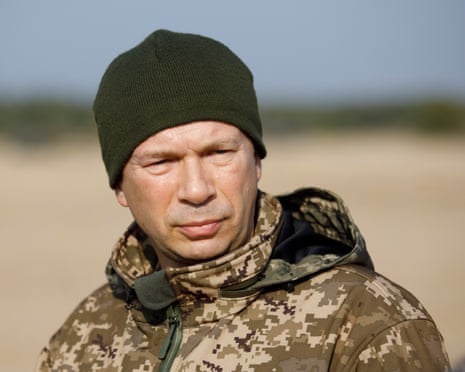 Oleksandr Syrskyi was credited with leading the defence of Kyiv and launching a counter-invasion of Russia’s Kursk province in summer 2024. Photograph: Vitalii Nosach/EPA
theguardian.com
Oleksandr Syrskyi was credited with leading the defence of Kyiv and launching a counter-invasion of Russia’s Kursk province in summer 2024. Photograph: Vitalii Nosach/EPA
theguardian.com
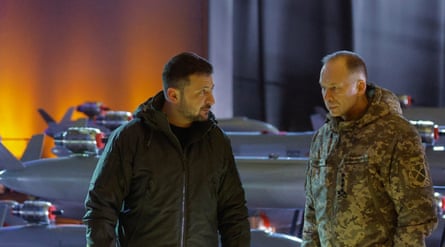 Volodymyr Zelenskyy with Oleksandr Syrskyi at the handover of drone missiles to the Ukrainian army in Kyiv in December 2024. Photograph: Sergey Dolzhenko/EPA
theguardian.com
Volodymyr Zelenskyy with Oleksandr Syrskyi at the handover of drone missiles to the Ukrainian army in Kyiv in December 2024. Photograph: Sergey Dolzhenko/EPA
theguardian.com
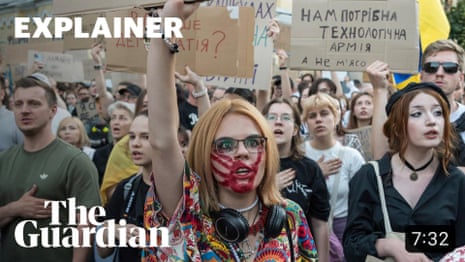 Why Ukrainians are protesting against Zelenskyy’s dismissal of defence minister – video
theguardian.com
Why Ukrainians are protesting against Zelenskyy’s dismissal of defence minister – video
theguardian.com
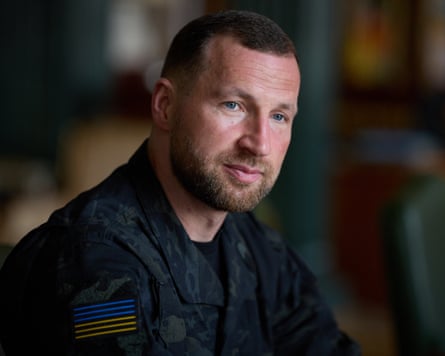 Yevhen Khmara replaced Mykhailo Fedeorov as Ukraine’s defence minister. Photograph: Ukrainian presidential press service/AFP/Getty Images
theguardian.com
Yevhen Khmara replaced Mykhailo Fedeorov as Ukraine’s defence minister. Photograph: Ukrainian presidential press service/AFP/Getty Images
theguardian.com
Volodymyr Zelenskyy has fired Ukraine’s commander-in-chief Oleksandr Syrskyi and named Major General Mykhailo Drapatyi to replace him, according to The Guardian. The move follows days of political tension after the dismissal of defence minister Mykhailo Fedorov, a decision that sparked protests in Kyiv and other cities.
The Guardian reports that Zelenskyy offered Fedorov—whom he sacked last week—a “prominent position”, after demonstrators demanded both Syrskyi’s removal and Fedorov’s reinstatement, with organisers threatening indefinite protests if the government did not reverse course. Drapatyi is described as well-regarded inside the military and publicly popular, and Ukrainian outlet Babel called him one of the country’s most capable battlefield commanders. His new assignment is framed less as frontline command than as an overhaul of the armed forces’ command structure, with a reorganisation mandate attached to the appointment.
The episode underlines how Ukraine’s war leadership is being shaped not only by battlefield outcomes but by internal coalition management. A commander-in-chief can be credited with major episodes—the defence of Kyiv early in the invasion, and a counter-invasion of Russia’s Kursk region in 2024—while still becoming politically expendable once a separate dispute breaks into the open. In this case, the dispute appears to have centred on how quickly the military adapts to drones, data and automation, with Fedorov arguing for a sharper shift toward technology-driven operations and lower casualty exposure, and Syrskyi defending the pace of integration.
Frequent reshuffles also change where accountability lands. When command is reorganised and senior figures are moved into new “prominent” roles rather than pushed out of state service, the personnel carousel can preserve unity in the short term while making it harder to pin responsibility for procurement, doctrine and operational decisions over time. It also signals to external backers that Ukraine’s leadership is balancing two audiences at once: partners funding the war effort and domestic constituencies watching the human cost.
Drapatyi’s reputation—built on years of fighting since Russia’s 2014 intervention and a public profile that extends beyond the officer corps—makes him a plausible bridge figure for a reform agenda that needs legitimacy inside the army and patience outside it. But the job description described in the reporting is not a clean promotion to battlefield command; it is an instruction to remodel a large institution while the war continues.
Zelenskyy thanked Syrskyi for his service and indicated he would be given another role within the state. On the streets, protesters had been demanding a reversal by Friday.