
Azerbaijan probes alleged Baku backchannel on Ukraine war
Aliyev says former German and Russian officials travelled in on overlapping flights, Merz says he knew nothing
Images
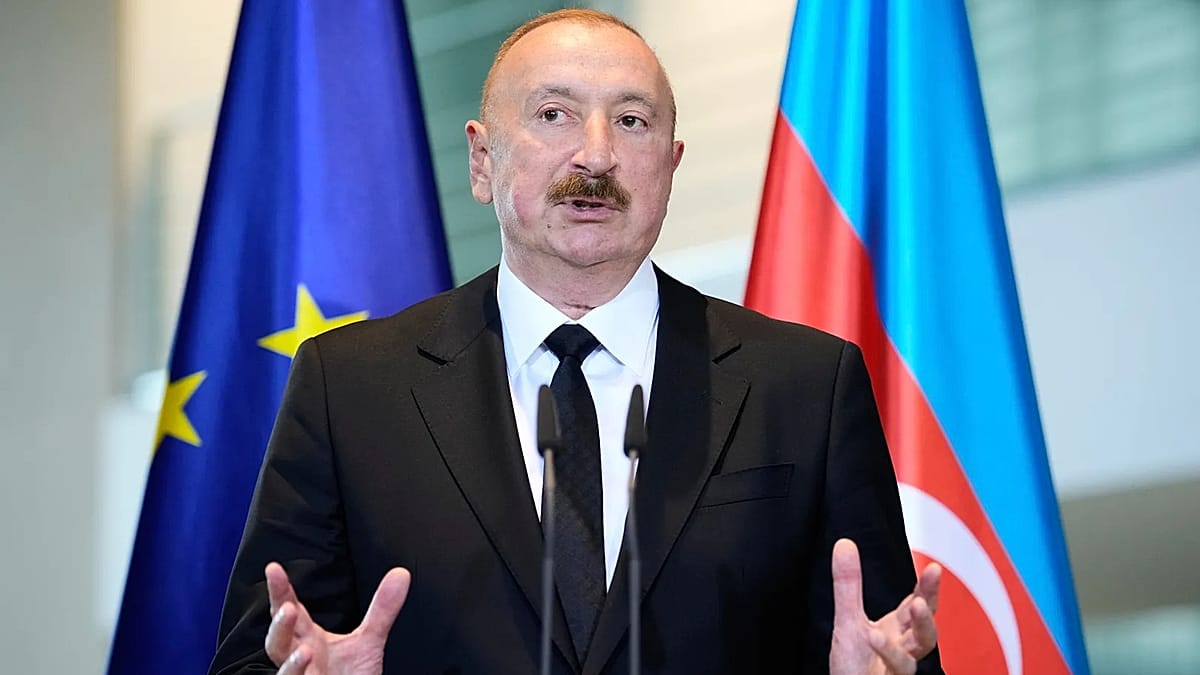 Aliyev says ex-Russian and German officials might have met in Baku
euronews.com
Aliyev says ex-Russian and German officials might have met in Baku
euronews.com
Two former senior German officials and two prominent Russians travelled to Baku on overlapping dates earlier this month, according to Euronews and comments by Azerbaijan’s president Ilham Aliyev. Aliyev said Azerbaijan was not notified and only learned after the fact that Ronald Pofalla and Matthias Platzeck arrived from Berlin on 12 July and left on 14 July, while Viktor Zubkov and Valery Fadeyev arrived from Moscow the same day and departed on 13 and 14 July.
Aliyev disclosed the travel overlap at a press conference in Berlin on 21 July alongside German Chancellor Friedrich Merz, framing it as a possible backchannel discussion about Russia’s war in Ukraine. He said “flight statistics” suggested a meeting and that Azerbaijan’s State Border Service investigated media reports and confirmed the visits. His complaint was procedural rather than strategic: Baku’s territory, he said, was used without its knowledge.
The names matter because none of the travellers are minor retirees. Pofalla ran the German chancellery under Angela Merkel and later worked at Deutsche Bahn; he also co-chaired the Petersburg Dialogue, a semi-official German-Russian forum Germany suspended in 2021. Platzeck, a former Social Democrat leader in Brandenburg, has been associated with pro-rapprochement currents in German politics through his role in a Russo-German cooperation forum. On the Russian side, Zubkov is a former prime minister and now chairs Gazprom’s board, while Fadeyev leads Russia’s Presidential Council for Civil Society and Human Rights, a body that has also served as a diplomatic interface.
Merz said he had no information about any alleged meeting in Baku. He used the moment to restate Berlin’s public line: that Germany has been trying for months to persuade Vladimir Putin to begin negotiations and that the decision “rests solely” with the Russian president. Aliyev, for his part, said he would welcome any contact that helps end the war, even as he ordered an inquiry into how it happened without Azerbaijan being told.
The episode underlines a recurring European pattern in long wars: official policy is negotiated in Brussels and national capitals, while unofficial channels test what can be said without paying the domestic price of saying it. If the travellers did meet, they picked a venue where flights can be tracked but agendas are harder to subpoena.
Aliyev’s account hinges on two sets of plane tickets and the fact that Azerbaijan says it was not asked for permission in advance.