
US strikes hit Iran for ninth night
IRGC warns Strait of Hormuz unsafe as shipping slows, oil jumps above $90 as risk replaces blockade
Images
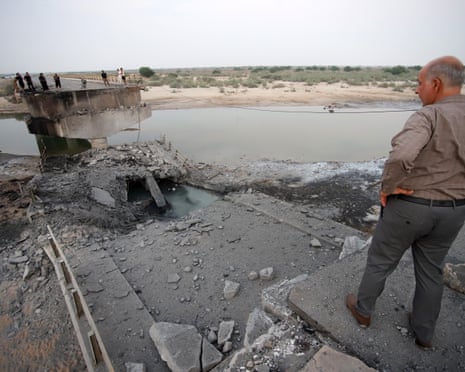 Damage to a bridge in southern Iran’s Hormozgan province on Sunday after a US strike. Photograph: Anadolu/Getty Images
theguardian.com
Damage to a bridge in southern Iran’s Hormozgan province on Sunday after a US strike. Photograph: Anadolu/Getty Images
theguardian.com
 Iran war live: Trump ‘planning for wider war’ with Tehran
independent.co.uk
Iran war live: Trump ‘planning for wider war’ with Tehran
independent.co.uk
US strikes hit Iranian cities for ninth night, Iran says Strait of Hormuz unsafe as oil rises above $90, shipping counts show disruption without formal blockade
US forces carried out a ninth consecutive night of strikes against Iran early Monday, with Iran’s semi-official Tasnim news agency reporting explosions in multiple cities including Tabriz, Chabahar and Bandar Imam Khomeini, according to the Guardian. US Central Command said the aim was to degrade Iran’s ability to attack commercial vessels in the Strait of Hormuz, while Iran’s Revolutionary Guard claimed retaliatory attacks on US targets in Kuwait and Jordan and said it had struck in Syria’s Al‑Tanf area. Oil prices jumped in early Asian trading, with Brent crude rising above $90 a barrel, as both sides framed the fight as a matter of protecting or denying global shipping lanes.
The gap between rhetoric and measurable disruption is narrowing. The Independent, citing LSEG shipping data, reported that only a handful of vessels crossed the Strait of Hormuz on Sunday, down from the previous day, and that traffic remained limited over the weekend even as neither side announced a complete closure. Iran’s Guard said the passage would remain unsafe “as long as US aggression” continued and warned that not even “a single drop” of oil or gas would pass, but the immediate mechanism has been risk rather than law: warnings, sirens, reported fires at sea, and the prospect that insurers and shipowners decide the route is not worth the premium.
That dynamic suits the operators of the conflict. A formal blockade would be an unmistakable act with clear thresholds for third-party intervention; a de facto slowdown is harder to attribute and easier to calibrate. The Guardian reported a late-Sunday report to the UK Maritime Operations centre that a vessel was on fire off the Omani coast, and the Revolutionary Guard claimed—without independent confirmation—that two oil tankers were blown up after attempting to transit. Even unverified claims can accomplish their purpose if they raise the perceived probability of loss for commercial shipping.
Washington, meanwhile, is signalling resolve while managing its own constraints. The Independent reported an unnamed American official telling the Washington Post that the US was rushing aircraft to the region and still planning for a wider war, but that operations could be limited by low stockpiles of air defences and long-range munitions. The Guardian said confirmed US military deaths in the renewed fighting had risen to three, and also reported broader casualty figures since the war began. Iran’s health ministry, for its part, cited dozens killed and hundreds injured in US strikes over the past three weeks.
For energy markets the result is a price response to uncertainty more than to physical scarcity. Brent briefly crossed $91 a barrel before easing, while traders watched the same chokepoint metrics shipowners watch: actual transits, loadings, and the willingness of crews to sail. If the strait stays technically open but functionally avoided, the world gets the costs of a closure—delays, rerouting, higher freight and insurance—without the clarity of a single decision point.
On Monday morning, sirens sounded in Bahrain and Gulf states reported intercepting drones and missiles. At the same time, a small number of commercial vessels still crossed the strait.