
Passenger ferry sinks off Guyana coast
MV Barima reported carrying 116 as search widens beyond one thousand square kilometres, compliance claims collide with survivor accounts of hours-long list
Images
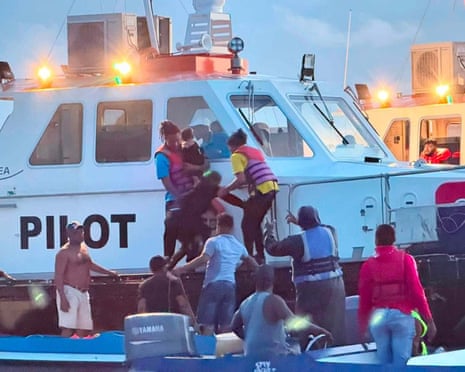 The Coast Guard, private aircraft, fishing vessels and civilian volunteers helped rescue passengers after the MV Barima sank on Saturday night. Photograph: Anadolu/Getty Images
theguardian.com
The Coast Guard, private aircraft, fishing vessels and civilian volunteers helped rescue passengers after the MV Barima sank on Saturday night. Photograph: Anadolu/Getty Images
theguardian.com
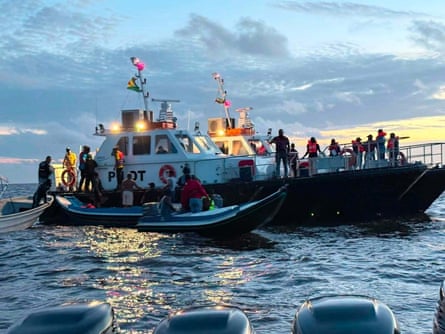 The emergency response involved the Coast Guard, the Air Corps and volunteer fishing vessels and private craft. Photograph: Anadolu/Getty Images
theguardian.com
The emergency response involved the Coast Guard, the Air Corps and volunteer fishing vessels and private craft. Photograph: Anadolu/Getty Images
theguardian.com
Overnight search teams in Guyana expanded their sweep of coastal waters after a passenger ferry sank with 116 people on board, according to The Guardian. Officials said 67 people had been rescued, including 15 children, after the MV Barima went down on Saturday night on a route from Georgetown to Port Kaituma in the Essequibo region near the Venezuelan border. A distress call was received shortly after 11pm, triggering a response that mixed state assets with private aircraft, fishing vessels and civilian volunteers.
The government has leaned early on paperwork: the public works minister, Juan Edghill, said preliminary checks suggested the vessel was operating within legal limits. The ferry was certified to carry far more passengers and cargo than it was listed as transporting, and officials said it had lifejackets, lifeboats and inflatable rafts. Yet survivors described a slow-building failure that did not look like a single sudden mechanical breakdown. One passenger, Adam Matabheek, told the paper he noticed the vessel leaning for hours before it rolled over, a detail that sits awkwardly beside official statements that there was no engine problem and that the incident was related to the tide.
In remote coastal economies, ferries are not just transport but moving warehouses. A manifest can show authorised cargo while the real constraint is how weight is distributed, how quickly water gets in, and whether passengers can reach flotation gear when a vessel flips. The Barima’s route runs toward an area where rivers and sea meet, with shifting channels and strong currents; local fisherfolk were brought into the search because they know the waters better than officials reading charts. The prime minister, Mark Phillips, said the search area was widened from 400 square kilometres to 1,070 square kilometres, a scale that underlines how quickly a single capsize becomes a resource problem.
The human cost tends to arrive in family clusters. Matabheek’s wife, Carlita, who cannot swim, was trapped inside the overturned vessel before reaching a lifejacket; she survived the night in the water and was eventually rescued. But his younger brother’s wife and three children remained missing, The Guardian reported, after the mother was thrown from a hammock and tried to reach them as they disappeared.
Guyana’s officials called it one of the country’s worst maritime disasters. The search now depends on aircraft time, fuel, and small boats scanning a widening grid over open water.