
China graduates 12.7 million students into weak job market
Universities scrap degrees and pivot to AI programs, entry-level work disappears faster than curricula can change
Images
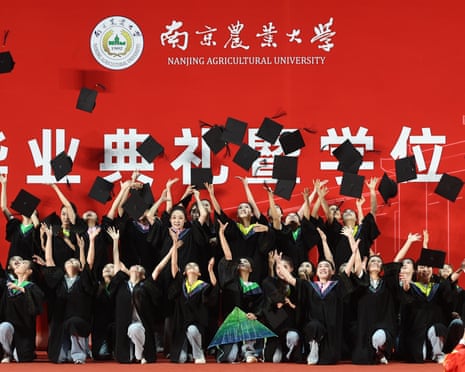 Graduates toss their caps in the air at a graduation ceremony at Nanjing Agricultural University. A record 12.7 million people graduated from college in China this year. Photograph: China News Service/Getty Images
theguardian.com
Graduates toss their caps in the air at a graduation ceremony at Nanjing Agricultural University. A record 12.7 million people graduated from college in China this year. Photograph: China News Service/Getty Images
theguardian.com
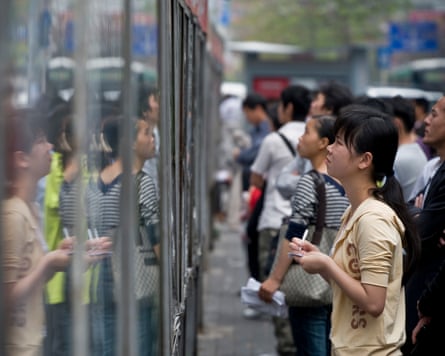 Job hunters check out adverts on a wall in Shenzhen. Many graduates fear unemployment. Photograph: Dan Chung/The Guardian
theguardian.com
Job hunters check out adverts on a wall in Shenzhen. Many graduates fear unemployment. Photograph: Dan Chung/The Guardian
theguardian.com
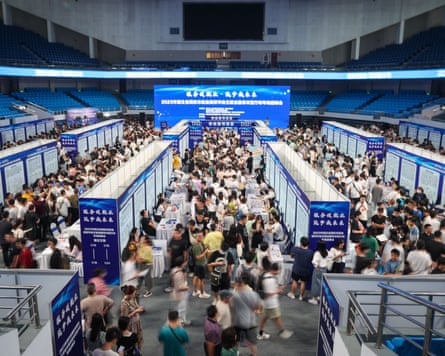 University graduates attend a job fair in Wuhan. An expert describes the jobs situation as ‘severe’. Photograph: AFP/Getty Images
theguardian.com
University graduates attend a job fair in Wuhan. An expert describes the jobs situation as ‘severe’. Photograph: AFP/Getty Images
theguardian.com
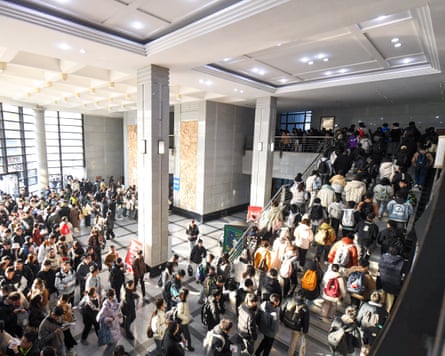 Candidates line up for the written exam for civil servants. Competition for vacancies is intense. Photograph: NurPhoto/Getty Images
Getty Images
Candidates line up for the written exam for civil servants. Competition for vacancies is intense. Photograph: NurPhoto/Getty Images
Getty Images
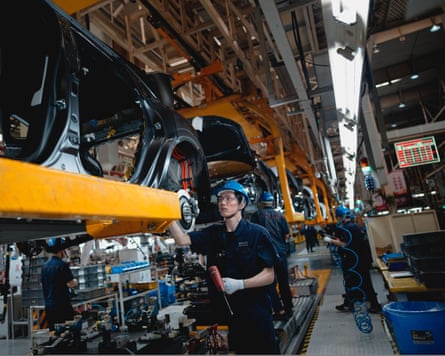 The graduate jobs crisis has been exacerbated by China’s focus on high-value industries such as electric vehicles, batteries, chips and robotics. Photograph: Alex Plavevski/EPA
theguardian.com
The graduate jobs crisis has been exacerbated by China’s focus on high-value industries such as electric vehicles, batteries, chips and robotics. Photograph: Alex Plavevski/EPA
theguardian.com
China produces a record 12.7 million new graduates this year, according to The Guardian, sending another cohort into a job market that has struggled to absorb young workers since 2020. The paper describes graduates firing off dozens or hundreds of applications for entry-level roles that do not exist in the numbers implied by university intake. Official data put youth unemployment for 16–24-year-olds at 15.6%.
The immediate problem is not a lack of activity in the Chinese economy but the kind of activity that is expanding. The Guardian reports that Beijing has been steering growth toward high-value manufacturing and productivity gains in sectors such as electric vehicles, batteries, semiconductors and robotics. Those industries can employ large workforces, but much of the new demand is for specific technical skills, while universities have been producing swelling numbers of generalist degrees. The result is a queue: millions of credentialed applicants competing for a thinner layer of white-collar starter jobs.
Automation tightens that queue from the other side. Entry-level work is often repetitive, supervised and easy to measure—exactly the sort of tasks companies can replace with software when budgets are tight. The Guardian notes that even graduates from IT services programs are seeing some junior tasks automated by AI, removing the traditional on-ramp where young workers learned by doing. Employers can then raise their requirements for the remaining openings, because the applicant pool is deep enough to let them.
Universities are responding at the speed of administration rather than the speed of labour markets. The Guardian reports that Chinese institutions are overhauling curricula and eliminating degrees they now label “obsolete,” with a heavy shift toward AI- and tech-focused programs. Central direction makes those changes unusually uniform: when Beijing sets a strategic line, hundreds of universities can pivot quickly. But a fast pivot can also mean a synchronized oversupply, with institutions chasing the same signals and producing the same graduates at scale.
For households, the costs are paid up front. Families finance years of study in the expectation that a degree buys a stable job; when that job is delayed or downgraded, the bill remains while earnings do not. For the state, the pressure is political as much as economic: each year’s graduating class is roughly the size of a medium-sized European country, and it arrives on the market all at once. The Guardian’s reporting makes clear that the bottleneck is not a single sector’s downturn but a structural mismatch between what students are trained to do and what employers are hiring for.
The Guardian’s profile of a young accounting graduate in Shanghai includes a simple metric: about 150 CVs sent in a month, with no offer. China’s universities will still hand out millions more diplomas next summer.