
Nesrine Malik: Tel Aviv rally spotlights torture claims in Israeli custody
Administrative detention and missing detainees widen accountability gap, prisons documented in photos while records stay opaque
Images
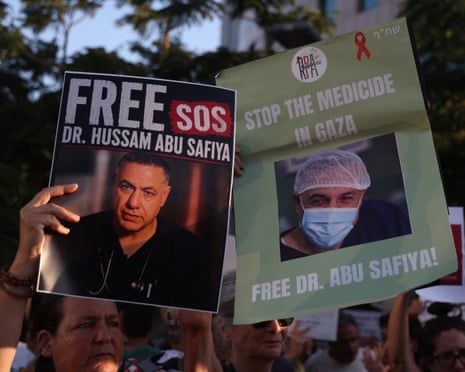 A rally in Tel Aviv calling for the release of detained Palestinian doctor Hussam Abu Safiya, 6 July 2026. Photograph: Anadolu/Getty Images
theguardian.com
A rally in Tel Aviv calling for the release of detained Palestinian doctor Hussam Abu Safiya, 6 July 2026. Photograph: Anadolu/Getty Images
theguardian.com
 Nesrine Malik
theguardian.com
Nesrine Malik
theguardian.com
A rally in Tel Aviv on 6 July called for the release of detained Palestinian doctor Hussam Abu Safiya, the former director of Kamal Adwan hospital in northern Gaza, according to a Guardian column by Nesrine Malik. Malik writes that Abu Safiya was seized by Israeli forces about 18 months ago and has been held without charge or trial, and that he describes severe abuse in custody.
The column’s core claim is not that mistreatment exists — it argues that the system now operates with less need to conceal it. Malik cites an image posted by an Israeli soldier in early July showing a Palestinian man from Gaza stripped to his underwear, bound and displayed, captioned “good morning” in Hebrew. The point of such photography is not operational necessity but signalling: it turns detention into a social-media artefact, a trophy that depends on the expectation that consequences will be limited.
Malik places Abu Safiya’s account in a wider structure of detention practices. She writes that he was transferred in June to Rakefet prison, an underground facility that was previously closed as inhumane and later reopened by Israel’s far-right national security minister Itamar Ben-Gvir. In Malik’s telling, prisoners there do not see daylight, which she says violates the Geneva Conventions. The facility’s design — underground, cut off from ordinary visibility — fits a system where the costs of abuse are kept off-budget: not necessarily financially, but reputationally and institutionally.
Administrative detention, Malik notes, can be renewed every six months indefinitely, and she puts the number held under it at roughly 3,500, including nearly 200 children. A mechanism framed as temporary and reviewable becomes, in repeated renewals, a parallel track that bypasses the burdens of open prosecution: evidence tests, public hearings, and the risk of acquittal. For security bodies, that reduces friction; for detainees, it replaces a clock with a loop.
The column also describes a separate accounting problem: who is even recorded as being held. Malik cites the Israel-based human rights group HaMoked as trying to trace the whereabouts of almost 2,000 people in Gaza whom eyewitnesses say were detained but never registered, which the organisation considers enforced disappearances. She adds that Israel has for decades withheld Palestinian bodies from families, including some buried in numbered graves in sealed military zones and others held in freezers, and that among them are Palestinians who died in custody without disclosed causes of death.
Abu Safiya’s story is presented as one file in a system that produces both detention and uncertainty — a body in a cell, a body in a freezer, or a name that never enters the ledger. The rally in Tel Aviv, Malik reports, was asking for a release. The state’s paperwork can still say, in effect, that there is no case to answer.