
Rokhaya Diallo: French appeal court upholds Marine Le Pen embezzlement conviction
EU fake-jobs scheme becomes campaign backdrop, sentence stays slow while politics stays fast
Images
 Marine Le Pen leaves Rassemblement National Party headquarters on July 8, 2026. Photograph: Abdullah Firas/ABACA/Shutterstock
theguardian.com
Marine Le Pen leaves Rassemblement National Party headquarters on July 8, 2026. Photograph: Abdullah Firas/ABACA/Shutterstock
theguardian.com
 Rokhaya Diallo
theguardian.com
Rokhaya Diallo
theguardian.com
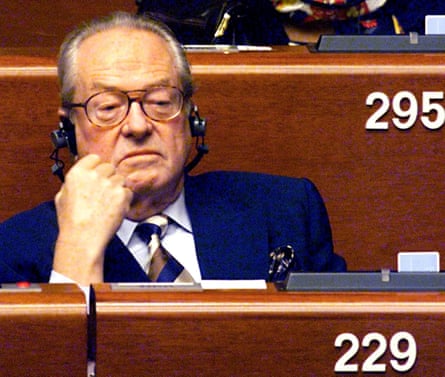 National Front leader Jean-Marie Le Pen at the European Parliament where he held a seat for 35 years Photograph: Gerard Cerles/EPA
theguardian.com
National Front leader Jean-Marie Le Pen at the European Parliament where he held a seat for 35 years Photograph: Gerard Cerles/EPA
theguardian.com
A French court of appeal has upheld Marine Le Pen’s conviction for orchestrating a long-running scheme that diverted European Parliament funds to her party’s work in France, according to a Guardian column by Rokhaya Diallo. The ruling, described by the court as “grave” in a lengthy written decision, still leaves Le Pen in public life — and she launched a 2027 presidential campaign within hours.
The case turns on a familiar political technology: money that is formally allocated for one purpose becomes a flexible resource once oversight is slow, fragmented, or politically inconvenient. The court found that the party — then the National Front, now Rassemblement National — claimed EU salaries for staff presented as MEP assistants even though the work was not carried out for the European Parliament. Among those paid, the piece notes, were figures tied directly to Le Pen’s personal apparatus, including a bodyguard and a longtime assistant, with funds allegedly flowing back to sustain party operations at home.
The investigation took years, and the conduct spanned multiple parliamentary terms — a timescale that matters. In practice, long timelines reward organisations that can treat legal risk as a manageable operating cost: the political benefits of staffing and organisation arrive immediately, while accountability arrives late, after elections have been fought and coalitions reshuffled. By the time a judgment lands, the public has often absorbed the scandal as background noise, and the defendant can recast the case as persecution rather than procurement.
Diallo’s column highlights how the appeal court simultaneously confirmed guilt and left space for continued political activity, including conditions that allow Le Pen to run while serving a sentence under electronic monitoring. The result is a hybrid outcome: a judicial finding strong enough to document a system, but not strong enough to remove the central figure from the arena in real time. That gap is where political entrepreneurs operate — not by disproving the facts, but by staying visible, fundraising, and campaigning while the highest court is asked to revisit the sentence.
The sums cited in the ruling — with early estimates by the European Parliament and a smaller amount proven in court — also point to an asymmetry between institutional damage and personal consequence. For a party, the value of years of paid staff time and operational continuity can exceed any single fine, especially when the publicity of the case itself becomes campaign material.
Le Pen left her party’s headquarters on 8 July, the Guardian notes, and began the next campaign the same day the appeal court reaffirmed her central role in the scheme. The electronic tag is stayed while France’s highest court considers her appeal.