
Mikel Merino sends Spain into World Cup semi-finals
Late substitute punishes Belgium after Courtois injury, one spilled shot becomes the margin
Images
 Mikel Merino wheels away, arms outstretched, after netting the winner late on. Photograph: Kai Pfaffenbach/Reuters
theguardian.com
Mikel Merino wheels away, arms outstretched, after netting the winner late on. Photograph: Kai Pfaffenbach/Reuters
theguardian.com
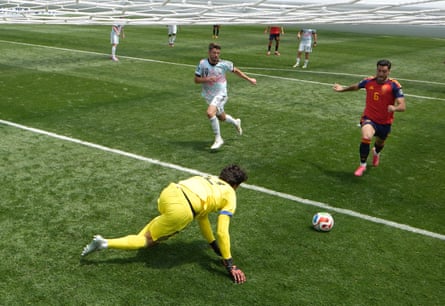 Mikel Merino closes in after Senne Lammens’s mistake. Photograph: David Ramos/Getty Images
theguardian.com
Mikel Merino closes in after Senne Lammens’s mistake. Photograph: David Ramos/Getty Images
theguardian.com
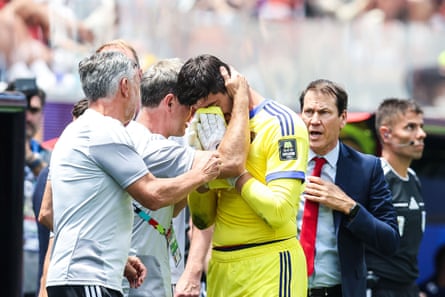 An emotional Thibaut Courtois goes off with an injury. Photograph: Bruno Fahy/Belga/Shutterstock
theguardian.com
An emotional Thibaut Courtois goes off with an injury. Photograph: Bruno Fahy/Belga/Shutterstock
theguardian.com
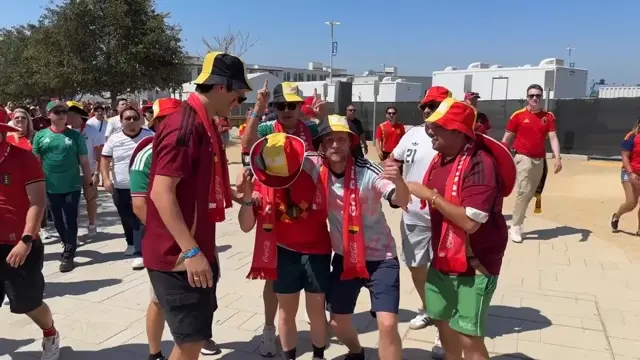 US: Spain faces Belgium in 2026 World Cup quarterfinal.
standard.co.uk
US: Spain faces Belgium in 2026 World Cup quarterfinal.
standard.co.uk
 standard.co.uk
Mikel Merino decides Spain’s World Cup quarter-final against Belgium with a late goal in Los Angeles, coming on in the closing minutes and scoring soon after as Spain win 2–1. According to The Guardian, Belgium’s first-choice goalkeeper Thibaut Courtois was injured and on the bench when the decisive moment arrived, leaving his replacement to deal with a long-range shot that spilled into Merino’s path. Spain now face France in the semi-final.
The match report reads like a catalogue of how tournament football compresses careers into a handful of touches. Spain had controlled long stretches, but the scoreboard moved on isolated sequences: a first-half Spanish goal created by pressure and a rebound, Belgium’s equaliser from a cross and a near-post header, and then a late mistake that turned a routine save into an elimination. The Guardian notes Spain’s attacking rhythm and Belgium’s reliance on bursts from players such as Jérémy Doku, while the Standard highlights Courtois being forced off with an apparent thigh injury before the winner.
For Belgium, the problem was not a lack of talent so much as the fragility of roles that usually sit in the background. Goalkeeping is priced like insurance: most matches are quiet, but the premium is paid for the one moment when a hand position, a parry angle, or a half-step decides the tournament. Spain’s bench, by contrast, functioned as a second starting XI; the winning goal came from a substitute arriving with fresh legs and a clear job description. That depth is expensive to assemble and hard to sustain across a season, but in a World Cup it becomes a form of risk management.
The reporting also captures how these matches are staged as global entertainment products while remaining brutally contingent. The Guardian describes a referee collision with a player and the stop-start texture of the game, reminders that even at the highest level the event is a live production with human friction. Players carry reputations built over years into a contest that can turn on a single rebound, and the broadcast spectacle does not soften the accounting: one team advances, one goes home.
Merino’s goal did not require a long spell of dominance, just a loose ball in the box and a clean finish. Belgium’s tournament ended on a save that was not held.