
NOAA warns El Niño is rapidly strengthening
Forecasters see high odds of very strong event by autumn, Europe tallies heatwave deaths as governments scramble for cooling and grid resilience
Images
 (AFP/Getty)
AFP/Getty
(AFP/Getty)
AFP/Getty
 People shield themselves from the sun at the Victoria Memorial outside Buckingham Palace in London. Photograph: Vuk Valcic/Sopa Images/Shutterstock
theguardian.com
People shield themselves from the sun at the Victoria Memorial outside Buckingham Palace in London. Photograph: Vuk Valcic/Sopa Images/Shutterstock
theguardian.com
 A firefighter sprays water on spectators watching the sixth stage of the Tour de France between Pau and Gavarnie-Gèdre in the French Pyrenees. Photograph: Loïc Venance/AFP/Getty Images
theguardian.com
A firefighter sprays water on spectators watching the sixth stage of the Tour de France between Pau and Gavarnie-Gèdre in the French Pyrenees. Photograph: Loïc Venance/AFP/Getty Images
theguardian.com
 A boy rests inside the Roman theatre in Arles, France. Photograph: Xinhua/Shutterstock
theguardian.com
A boy rests inside the Roman theatre in Arles, France. Photograph: Xinhua/Shutterstock
theguardian.com
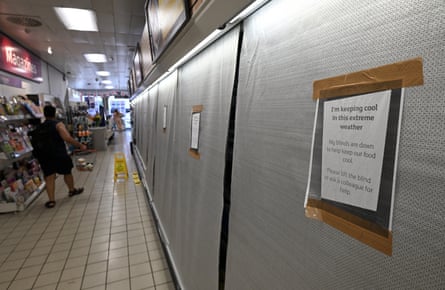 Signs on blinds covering fridges in the chilled food aisle of a Sainsbury’s supermarket in England. Photograph: Justin Tallis/AFP/Getty Images
theguardian.com
Signs on blinds covering fridges in the chilled food aisle of a Sainsbury’s supermarket in England. Photograph: Justin Tallis/AFP/Getty Images
theguardian.com
Ocean temperatures in the tropical Pacific have warmed fast enough that U.S. forecasters now give an intensifying El Niño an 81% chance of reaching the top “very strong” category by autumn, according to the U.S. National Oceanic and Atmospheric Administration. In western Europe, the same week brought confirmation that June was the hottest on record, as the UK entered its third heatwave of the year, the Guardian reports. Health agencies in England expanded heat alerts while meteorologists warned high temperatures would persist into next week.
El Niño is a recurring Pacific pattern, but the timing matters: it formed last month and has already moved from weak to moderate strength, with key ocean regions at or near record warmth for the season, NOAA scientists said. That early surge loads the dice for the months when El Niño typically reshapes weather most strongly—autumn and winter—raising the odds of drought in some regions, heavy downpours in others, and a global bump in heat as stored ocean warmth is released into the atmosphere. Climate researchers quoted by the Independent note that the event is arriving on top of higher background temperatures driven by fossil-fuel burning, making record-breaking conditions easier to reach even if El Niño does not “guarantee” extremes in every place.
Europe’s summer already offers a ledger of how quickly heat translates into measurable harm. Belgium’s public science institute reported 1,747 excess deaths in June linked to the heatwave, while Germany’s Robert Koch Institute reported 5,120 heat-related deaths during the summer, according to the Guardian. Early academic estimates cited by the paper suggest the heatwave death toll across Europe this summer could exceed 20,000. Governments are responding with the tools they can deploy in days—alerts, public messaging, temporary cooling measures—while the harder work sits in the housing stock and infrastructure that determine who can escape indoor heat.
France’s High Council on Climate, in its annual report, urged transforming homes from “thermal kettles” into decent housing and called for shutters, shade structures, fans and cooling systems in hospitals, care homes and schools, the Guardian reports. The same heat can also collide with power generation: a French nuclear reactor reportedly shut down because of high temperatures. These are not abstract climate targets; they are operational constraints that surface first in emergency rooms, care facilities and the grid.
Forecasters also expect a strong El Niño to dampen the Atlantic hurricane season, and Colorado State University has already cut its storm predictions as confidence in El Niño grows, the Independent reports. But the quieter hurricane outlook does not offset the broader pattern: a warmer ocean and a warmer baseline make heat and water extremes more frequent visitors.
On Thursday, England’s heat alerts spread to almost the entire country as temperatures stayed high. In the Pacific, the same day’s NOAA update described an ocean pattern that has only just begun to spend its stored heat.