
US Justice Department threatens election officials with prosecution
Harmeet Dhillon letters warn states over noncitizen voters on rolls, voter data fight expands into DHS cross-checks after court losses
Images
.jpeg) Harmeet Dhillon, the assistant attorney general for civil rights, (pictured center) sent letters threatening criminal action against state election officials if they knowingly permit non-citizens to vote (Getty Images)
Getty Images
Harmeet Dhillon, the assistant attorney general for civil rights, (pictured center) sent letters threatening criminal action against state election officials if they knowingly permit non-citizens to vote (Getty Images)
Getty Images
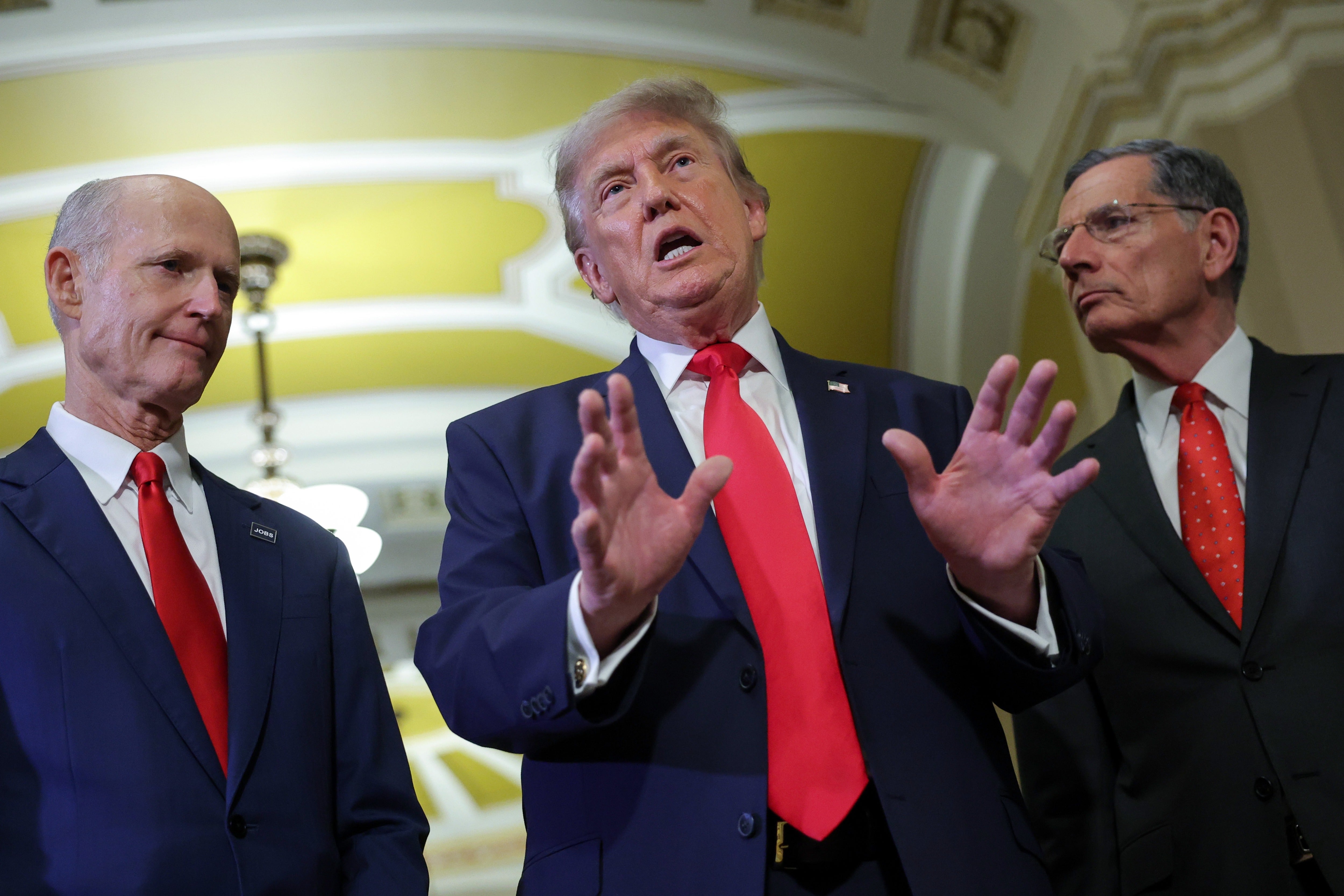 President Trump, who has repeatedly and baselessly insisted that US elections are riddled with widespread fraud, has pushed lawmakers to pass the SAVE America Act, which would require new voters to show proof of citizenship. Last month, he met with GOP lawmakers on Capitol Hill, urging them to get it passed (Getty Images)
Getty Images
President Trump, who has repeatedly and baselessly insisted that US elections are riddled with widespread fraud, has pushed lawmakers to pass the SAVE America Act, which would require new voters to show proof of citizenship. Last month, he met with GOP lawmakers on Capitol Hill, urging them to get it passed (Getty Images)
Getty Images
The US Justice Department has warned election officials across all 50 states that they could face criminal liability if they knowingly allow noncitizens to remain on voter rolls or to vote. According to The Independent, the letters were sent by Harmeet Dhillon, the assistant attorney general for civil rights, and urged officials to contact the department about steps to keep voter lists “clean” under existing law.
The letters land in a political environment where the administration is trying to turn election administration into a law-enforcement problem. President Donald Trump has pushed Congress to pass the SAVE America Act, which would require proof of citizenship for new voter registrations, and has floated the idea of deploying National Guard troops or ICE agents to polling places. A Justice Department spokesperson told CBS News the letters seek “voluntary compliance” with federal law for federal elections, while the department is also in litigation with multiple states to obtain voter-roll data that it says will be used to enforce compliance.
The friction point is not the formal principle—only citizens can vote in federal elections—but the leverage created by criminal threats and data demands. States control election administration, including how they maintain registration lists and what personal information they disclose. The Independent reports that Utah’s lieutenant governor, Deidre Henderson, a Republican and the state’s top election official, said she viewed the letters as threats of prosecution for officials who are following state and federal law while resisting federal demands for private voter data. She pointed to court rulings that have blocked Justice Department efforts to obtain what she described as private voter information.
The department’s approach also relies on information-sharing between agencies with different missions. DOJ officials have said voter-roll records would be shared with the Department of Homeland Security to check for noncitizen voters, according to the report. That turns a dispute over list maintenance into a pipeline for immigration enforcement, raising the cost for states that hand over records and the cost for individuals whose data is used for cross-checking.
The administration’s legal record in this area is mixed at best. The Independent notes that the Justice Department has lost multiple district court cases related to its efforts to obtain “uncensored” voter rolls, according to CBS News. Meanwhile, Arizona’s secretary of state, Adrian Fontes, issued a lengthy response defending his state’s election measures, signalling that some states intend to litigate rather than comply.
The letters are framed as routine enforcement of existing statutes. But they arrive as a mass mailing from Washington that asks local election administrators to treat their daily work as potential criminal exposure—and to send the underlying data to federal agencies that have their own reasons for wanting it.