
Nato summit opens in Ankara
Allies unveil new surveillance and anti-drone buys as Trump presses spending targets, procurement choices decide who carries the bill
Images
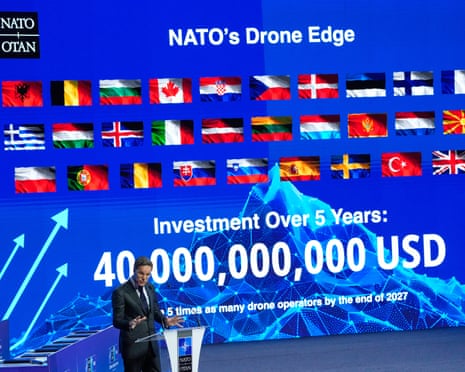 Nato Secretary General Mark Rutte speaks during the Nato Defense Industry Forum at the NATO summit in Ankara, Turkey. Photograph: Hussein Malla/AP
theguardian.com
Nato Secretary General Mark Rutte speaks during the Nato Defense Industry Forum at the NATO summit in Ankara, Turkey. Photograph: Hussein Malla/AP
theguardian.com
Nato leaders meet in Ankara this week with a shopping list that reads like a procurement catalogue: billions earmarked for anti-drone defences, new surveillance aircraft to replace the alliance’s ageing AWACS fleet, and high-altitude drones intended to watch wide swathes of territory at once. According to Reuters, Nato plans to buy up to 10 GlobalEye surveillance planes from Sweden’s Saab and up to five Northrop Grumman MQ-4C Triton drones, as member states face renewed pressure—led by Donald Trump—to raise defence spending.
The spending argument is not just about totals; it is about who gets paid, what gets built, and how quickly equipment can be fielded. Anti-drone systems are a fast-growing market because they offer a relatively cheap way to blunt expensive missiles and aircraft, and because the Ukraine war has turned drones into routine artillery. But pooled Nato purchases also centralise decisions that used to be made nationally: common stockpiles of “critical defence materials”, and shared arrangements to acquire, store, transport and manage them, shift leverage toward the alliance’s bureaucracy and the largest buyers.
The choice of Saab over Boeing for the new surveillance aircraft, as Reuters describes it, lands inside a long-running European complaint: that “collective defence” often becomes a one-way procurement channel into US industry. A Swedish win is still a Nato win, but it changes the distribution of jobs, maintenance contracts and political credit. The Triton plan points the other way—toward a US platform—yet it also shows how smaller states are trying to buy capability they cannot afford alone. Reuters reports Norway, Finland, Germany and Denmark signing a letter of intent tied to the Triton purchase, a reminder that the alliance’s high-end surveillance is increasingly a consortium product.
The summit’s timing makes the internal bargaining harder to ignore. Ukraine remains the war that sets Nato’s pace, but the alliance is meeting under open talk of spending targets and burden-sharing rather than under a single, unifying operational plan. When leaders argue over percentages, they are also arguing over which threats get priority: drones over armour, surveillance over ammunition, stockpiles over surge production. Each choice locks in suppliers for years.
Mark Rutte, Nato’s secretary general, addressed the Nato Defence Industry Forum alongside the summit, underlining that this is as much an industrial mobilisation as a diplomatic gathering. In Ankara, the alliance is announcing purchases that can be counted immediately, even as the harder question—who will pay for the next round—remains unresolved.