
Ravi Holy: King Charles recasts defender of the faith role
Sovereign grant report calls him protector of faith space in multifaith Britain, critics argue over a line with unclear authorship
Images
 King Charles and Queen Camilla with the Archbishop of Canterbury, Sarah Mullally (left), at St Peter's church in Wolferton, on the Sandringham estate, Norfolk, 25 January 2026. Photograph: Joe Giddens/PA
theguardian.com
King Charles and Queen Camilla with the Archbishop of Canterbury, Sarah Mullally (left), at St Peter's church in Wolferton, on the Sandringham estate, Norfolk, 25 January 2026. Photograph: Joe Giddens/PA
theguardian.com
 theguardian.com
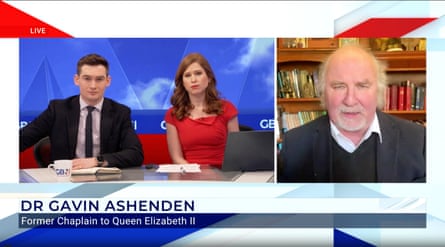 The former chaplain to the queen, Gavin Ashenden, talking about religion on GB News, 5 March 2025. Photograph: GB News
theguardian.com
The former chaplain to the queen, Gavin Ashenden, talking about religion on GB News, 5 March 2025. Photograph: GB News
theguardian.com
King Charles attended a service at St Peter’s church in Wolferton on the Sandringham estate in Norfolk on 25 January 2026, a small scene that has since been pulled into a larger argument about what the monarchy is for. According to The Guardian, the latest annual sovereign grant report describes the king as a “protector of the space for faith within the multifaith nation,” language that sits uneasily beside the traditional title “defender of the faith.” The paper reports that the wording has been treated by some critics as a constitutional and religious provocation.
The dispute turns on who gets to define continuity. Dr Gavin Ashenden, described by The Guardian as a former chaplain to Queen Elizabeth II and a regular GB News guest, has argued that the king’s approach amounts to betrayal. The column notes Ashenden’s wider commentary, including claims of a “woke takeover” of the church and statements suggesting Islam is inherently and uniquely violent. Others quoted by The Guardian include Ciarán Kelly, director of the Christian Institute, who says Christianity is the bedrock of the UK’s laws and culture and reads the multifaith framing as downgrading Christianity to one option among many.
Yet the story is also about how little control anyone can prove. The Guardian says it is uncertain whether Charles personally wrote the disputed line in the sovereign grant report. The monarchy’s public language is often the product of officials, committees and careful drafting, designed to offend as few people as possible while still signalling something. That makes the backlash a kind of shadow-boxing: critics argue over a sentence while the authorship remains unclear, and the institution can neither fully own the message nor convincingly disown it.
The king’s preferences, however, are not new. The Guardian points to a 1994 interview with Jonathan Dimbleby in which Charles said he would prefer to be a defender of faith in general rather than of one particular faith. That earlier remark triggered opposition from conservative Christians, including the grand secretary of the Grand Orange Lodge of Scotland, and warnings from John Habgood, then archbishop of York, that the stance could cause the British constitution to unravel. The paper also notes that Queen Elizabeth II later expressed a similar multifaith view in a speech at Lambeth Palace, describing the Church of England’s role as creating space for other faith communities and people of no faith to live freely, rather than defending Anglicanism alone.
That continuity matters because today’s argument is being sold as a rupture. The Guardian frames the multifaith approach as rooted in the post-Reformation settlement, when states moved away from enforcing a single version of Christianity. In that reading, “protector of the space for faith” is less a modern innovation than a restatement of a long-running compromise: a national church intertwined with the state, alongside a society that has outgrown uniform belief.
The practical question is what changes when the monarch changes his wording. The sovereign grant report line has generated accusations of treachery, but the king still turns up at an Anglican church on a royal estate, and the constitutional machinery remains where it has always been.