
Slow-motion video links bumblebee mouth movements to liking and disliking
PNAS study tests sugar salt and quinine across 18 colonies, heat stress flips reactions to water and salt
Images
 A new study suggests that bees exhibit 'emotion-like' behaviours; when they taste something good, for instance, they stick out their glossa (tongues) afterwards. Photograph: The Bee Lab at Southern Medical University
theguardian.com
A new study suggests that bees exhibit 'emotion-like' behaviours; when they taste something good, for instance, they stick out their glossa (tongues) afterwards. Photograph: The Bee Lab at Southern Medical University
theguardian.com
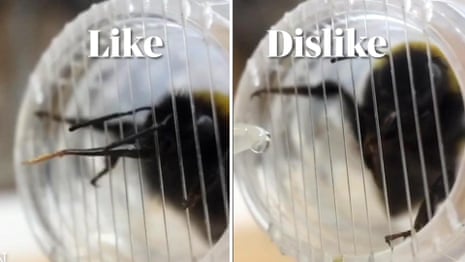 Slow-motion footage of bumblebees shows how they react when they 'like' or 'dislike' things – video
theguardian.com
Slow-motion footage of bumblebees shows how they react when they 'like' or 'dislike' things – video
theguardian.com
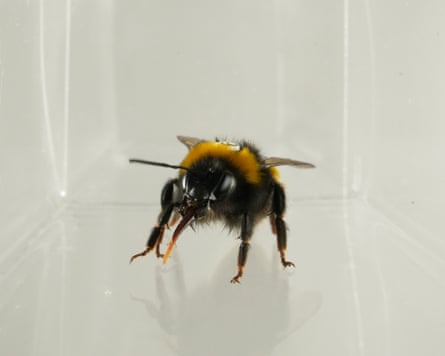 In insects like bees, the concept of an inner life remains ‘highly controversial’, Prof Andrew Barron says. Photograph: The Bee Lab at Southern Medical University
theguardian.com
In insects like bees, the concept of an inner life remains ‘highly controversial’, Prof Andrew Barron says. Photograph: The Bee Lab at Southern Medical University
theguardian.com
Slow-motion video of bumblebees tasting sweet, salty and bitter droplets suggests they show consistent “liking” and “disliking” behaviours, according to The Guardian. The study, published in Proceedings of the National Academy of Sciences, is a collaboration between Macquarie University and Southern Medical University in China.
The researchers focused on mouthpart movements that, in mammals, are used as behavioural markers of internal states when animals cannot report what they feel. In the experiments, bumblebees were presented with droplets of 60% sugar, 20% sugar, plain water, 5% salt, or a quinine solution. After sweet solutions, bees showed what the paper calls “post-consumption glossa”—continued tongue extension and licking. With salt or quinine, bees instead shook their heads and wiped their mouthparts, reactions the scientists compare to distaste responses documented in rats and other mammals.
The controversial step is moving from “observable response” to “subjective experience”. The Guardian reports that the authors attempted to separate simple chemical reflexes from state-dependent behaviour by testing 18 bumblebee colonies under different conditions, including heat stress, satiety and drug doses. Under heat, bees’ reactions to water or salty solutions shifted from neutral or aversive to positive. Co-author Andrew Barron, an insect behaviour researcher at Macquarie University, likened that shift to a human’s changed perception of an electrolyte drink after heavy exertion.
If the behaviours track internal state rather than fixed reflex, they become a tool: a way to quantify how environmental stressors alter what bees seek out and avoid. That matters because conservation policy often depends on measurable endpoints—colony numbers, foraging rates, pesticide exposure—while welfare and cognition debates tend to stall over definitions. A repeatable behavioural readout could feed into how researchers assess sub-lethal harms from heat, chemicals, or habitat change, and into how interventions are evaluated.
The same tool also invites disputes about interpretation. Facial expressions are treated as important indicators in many animals, but insects occupy an uneasy category in public policy: ecologically essential, widely managed by humans, and rarely granted the moral assumptions applied to vertebrates. The study adds another dataset to that argument, without resolving where “emotion-like” ends and “adaptive motor program” begins.
In the videos, the difference is plain: sweet droplets are followed by lingering tongues, while bitter ones trigger head shakes and mouth wiping. The paper’s strongest claim is not that bees talk to themselves, but that their reactions change with conditions in ways that look less like a switch and more like a state.