
Turkey expands pre Nato summit arrests
Ankara protest ban runs until mid July and comedian faces pre trial detention, alliance meeting lands in narrowed public square
Images
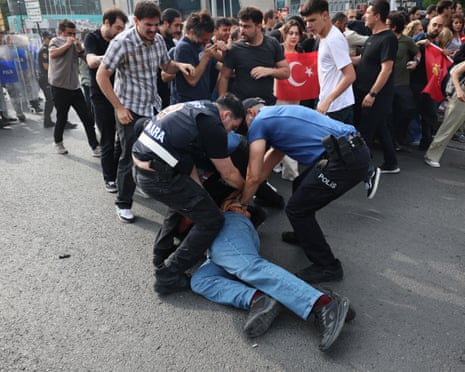 Turkish police detain a protester during an anti-Nato demonstration in Ankara on Sunday. Photograph: Adem Altan/AFP/Getty Images
theguardian.com
Turkish police detain a protester during an anti-Nato demonstration in Ankara on Sunday. Photograph: Adem Altan/AFP/Getty Images
theguardian.com
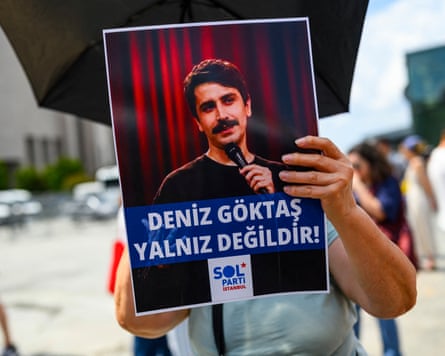 People call for the release of the Turkish comedian Deniz Göktaş in front of a courthouse in Istanbul on Friday. Photograph: Yasin Akgül/AFP/Getty Images
theguardian.com
People call for the release of the Turkish comedian Deniz Göktaş in front of a courthouse in Istanbul on Friday. Photograph: Yasin Akgül/AFP/Getty Images
theguardian.com
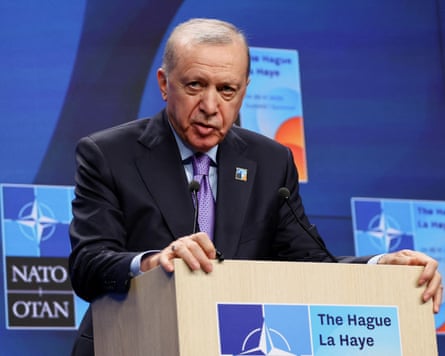 Prosecutions for criticising Recep Tayyip Erdoğan have risen sharply in recent years. Photograph: Piroschka Van De Wouw/Reuters
theguardian.com
Prosecutions for criticising Recep Tayyip Erdoğan have risen sharply in recent years. Photograph: Piroschka Van De Wouw/Reuters
theguardian.com
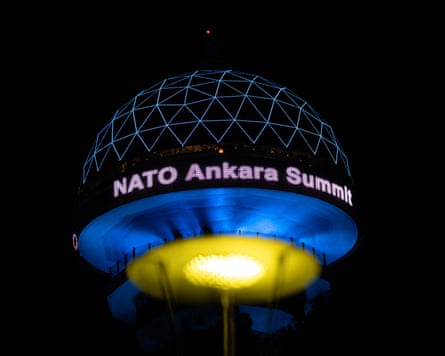 A view of Atakule, one of the landmark buildings of Ankara, is illuminated in the run-up to the Nato summit, which starts on Tuesday. Photograph: Anadolu/Getty Images
theguardian.com
A view of Atakule, one of the landmark buildings of Ankara, is illuminated in the run-up to the Nato summit, which starts on Tuesday. Photograph: Anadolu/Getty Images
theguardian.com
Turkish police detain critics ahead of Nato summit, arrests and protest bans tighten public space in Ankara, alliance meeting proceeds under emergency-style policing
Turkish authorities have detained more than 200 people in raids across Ankara in late June and imposed a ban on demonstrations in the capital until 10 July, according to The Guardian. The sweep comes as Nato leaders prepare to meet in Ankara, with Human Rights Watch saying the arrests and blanket protest restrictions show shrinking room for speech and assembly in a country hosting one of the alliance’s most visible gatherings.
The crackdown has extended beyond street protests. The Guardian reports that standup comedian Deniz Göktaş was arrested and placed in pre-trial detention after arriving at Istanbul airport, facing charges including “insulting the president” and “denigrating religious values” over a performance in Istanbul on 1 June. A recording of the set, posted to YouTube on 24 June, drew close to 9 million views, turning a local stage routine into a national test of what can be said about President Recep Tayyip Erdoğan without triggering prosecutors.
The same week, authorities in the coastal town of Aydın blocked a cruise ship operated by Atlantis, a gay-friendly holiday company, from docking, citing passengers “known for behaviours” said not to align with the society’s moral values, The Guardian reports. The ship carried about 2,000 LGBTQ+ passengers, and US actor and singer Patti LuPone, scheduled to perform, said on social media the ship was barred because of who was on board.
Two journalists were also arrested on Sunday, including Buse Söğütlü of T24 and Ceren Erdoğdu of OdaTV, with Söğütlü’s lawyer telling Agence France-Presse the detentions were believed to be linked to the summit, according to The Guardian. Ankara’s prosecutor’s office has framed the late-June dawn raids as an effort to “decipher the actions and activities of terrorist organizations,” an elastic justification that allows security services to treat political mobilisation as a counterterrorism problem.
Turkey has spent years presenting itself to Nato as both indispensable and embattled: a frontline state bordering war zones, a gatekeeper for migration routes, and a military power that allies need even when relations are strained. Hosting a summit raises the reputational stakes, but it also concentrates foreign press, visiting delegations, and domestic protest energy in one place. A demonstration ban and mass detentions reduce the risk of disruptive images on summit television feeds, while the legal exposure created by “insult” prosecutions pushes public figures and journalists into self-censorship without requiring an explicit censorship order.
Reporters Without Borders has accused Turkey of using every available means to undermine critics, and ranks the country 163rd out of 180 on its press freedom index, The Guardian notes. The summit’s security perimeter, in that sense, is not just physical: it is built from pre-trial detention, broadly worded offences, and municipal decisions about who gets to dock.
Nato leaders are still expected to arrive in Ankara on Tuesday. In the days before they do, Turkey has been arresting comedians and banning demonstrations in the host city.