
Chinese start-ups scale robotic hands production
Beijing pushes embodied AI as workforce ages, mass manufacturing runs ahead of real-world deployment
Images
 Five-fingered robotic hands
theguardian.com
Five-fingered robotic hands
theguardian.com
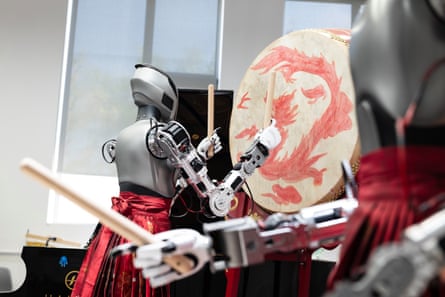 A humanoid robot wearing a traditional mamianqun skirt strikes a Chinese drum at the Linkerbot office in May in Beijing. Photograph: Emmanuel Wong/The Guardian
theguardian.com
A humanoid robot wearing a traditional mamianqun skirt strikes a Chinese drum at the Linkerbot office in May in Beijing. Photograph: Emmanuel Wong/The Guardian
theguardian.com
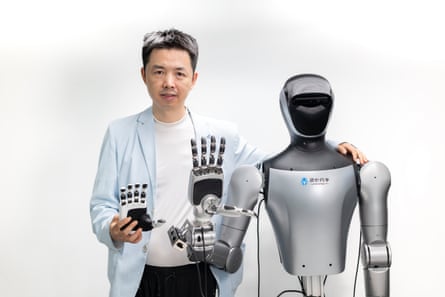 Alex Zhou, founder of tech startup Linkerbot, poses for a photo alongside a humanoid robot and a robotic dextrous hand at the company’s office in May in Beijing. Photograph: Emmanuel Wong/The Guardian
theguardian.com
Alex Zhou, founder of tech startup Linkerbot, poses for a photo alongside a humanoid robot and a robotic dextrous hand at the company’s office in May in Beijing. Photograph: Emmanuel Wong/The Guardian
theguardian.com
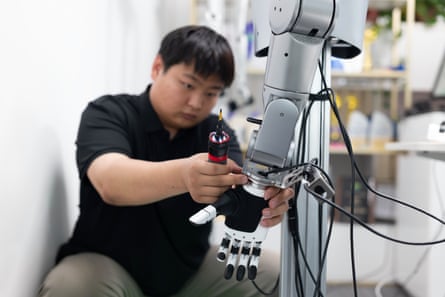 A technician calibrates a robotic dextrous hand mounted on a mechanical arm at Linkerbot. Photograph: Emmanuel Wong/The Guardian
theguardian.com
A technician calibrates a robotic dextrous hand mounted on a mechanical arm at Linkerbot. Photograph: Emmanuel Wong/The Guardian
theguardian.com
 Humanoid robots playing music
theguardian.com
Humanoid robots playing music
theguardian.com
LinkerBot says it is making about 5,000 robotic hands a month, as Beijing leans into “embodied AI” and Chinese start-ups race to turn humanoid robots into something more than a stage act, according to The Guardian. The company’s founder, Zhou Yong, describes hands as the hardest part of building useful humanoids, and says the dexterity problem is “one hundred times more difficult” than building the rest of the robot.
The focus on hands is a clue to where China thinks the bottleneck is. Industrial robots already dominate factory floors, and The Guardian notes China installs more than half of the world’s factory robots each year. Humanoid robots, by contrast, still struggle with the unglamorous tasks that make them economically legible: picking up irregular objects, manipulating soft materials, and doing work that cannot be simplified into a fixed production line. The International Federation of Robotics has warned that true multipurpose humanoids remain far off, and even Tesla’s Elon Musk has publicly singled out hands as the bulk of the engineering difficulty.
China’s pitch is that it can brute-force the problem with manufacturing depth and political backing. The Guardian describes start-ups using China’s component supply chains and an official push for embodied AI, a term that folds sensors, models and mechanical control into a single industrial programme. The Communist party’s journal Qiushi has framed embodied-intelligence robots as opening new “trillion-yuan” markets, language that tends to pull local governments, subsidies and state-linked capital into the same direction of travel.
That mix changes what gets built. When a technology is treated as a national project, prototypes can be funded long before customers exist, and companies can scale production in anticipation of a market that is still mostly promised. The Guardian reports LinkerBot is chasing a multi-billion-dollar valuation while planning to double production, and it describes a domestic consumer fascination with humanoids after a troupe of dancing robots appeared on China’s Spring Gala broadcast. Public enthusiasm can sustain headlines, but it does not automatically price in maintenance, safety, liability, or the cost of robots breaking in ordinary homes.
The demographic argument is also doing work in the background. Chinese policymakers and technologists present robotics as a response to an ageing, shrinking workforce, but the immediate buyers for advanced hands are more likely to be factories, logistics firms and security-related applications than households. A hand that can reliably grasp, twist, and manipulate tools is valuable wherever labour is costly, supervision is thin, and mistakes can be externalised.
For now, the most concrete metric is the one LinkerBot itself offers: thousands of hands leaving a production line each month, while the general-purpose humanoid that would need them remains a product video more than a product category.