
Thunderstorm evacuation disrupts Trump National Mall event
Extreme heat and security queues turn leaving into a standoff, chair temperatures and power outages show how thin the safety margin gets
Images
 Attendees evacuate the National Mall in Washington DC due to incoming storms, on 4 July. Photograph: ABACA/Shutterstock
theguardian.com
Attendees evacuate the National Mall in Washington DC due to incoming storms, on 4 July. Photograph: ABACA/Shutterstock
theguardian.com
 A woman complains about being asked to leave as members of the US Secret Service direct people to evacuate. Photograph: Alex Wroblewski/AFP/Getty Images
theguardian.com
A woman complains about being asked to leave as members of the US Secret Service direct people to evacuate. Photograph: Alex Wroblewski/AFP/Getty Images
theguardian.com
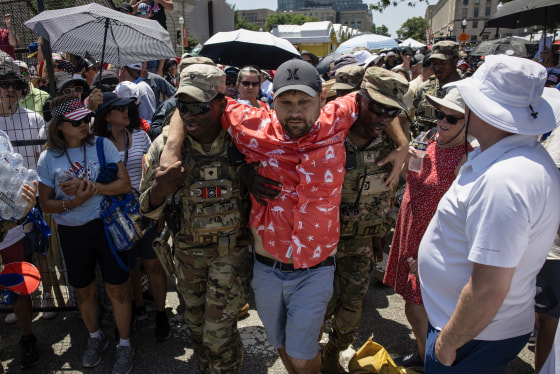 Two soldiers in camouflage help carry a man through a crowd.
nbcnews.com
Two soldiers in camouflage help carry a man through a crowd.
nbcnews.com
 nbcnews.com
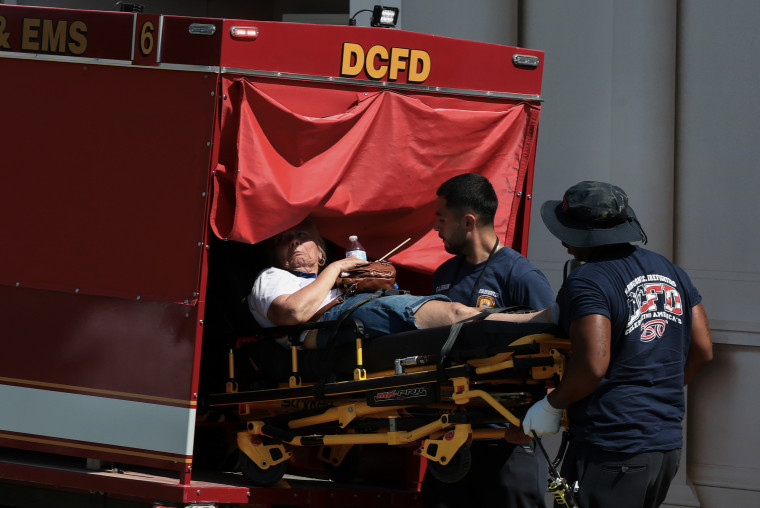 Emergency workers providing assistance to another tourist at the Great American State Fair in Washington on Saturday.Joe Raedle / Getty Images
nbcnews.com
Emergency workers providing assistance to another tourist at the Great American State Fair in Washington on Saturday.Joe Raedle / Getty Images
nbcnews.com
Thousands of people were told to clear the National Mall in Washington on July 4 as thunderstorms approached, interrupting Donald Trump’s planned “America 250” celebration and fireworks. According to the Guardian, the evacuation order came after spectators had waited through heavy security, and the Secret Service repeated the instruction about an hour later as the sky darkened.
The disruption landed on top of an extreme heatwave that had already warped the holiday’s logistics across the US east coast. NBC News reports that nearly 156 million people were under National Weather Service heat alerts across the eastern two-thirds of the country, with temperatures above 100°F in places including Washington, D.C. At the Mall, emergency workers and National Guard members treated heat-related ailments while general seating sat in direct sun; NBC describes chair temperatures measured at 160°F and pallets of bottled water stocked in the sunlight. The same crowd asked to leave for lightning risk had, hours earlier, absorbed a different message: stay outside, endure the heat, and wait for the headline moment.
The day’s weather also exposed how quickly civic spectacle turns into crowd-management. The Guardian describes booing after the Secret Service urged people to evacuate, with chants of “USA” and “We want Trump” continuing as conditions worsened. NBC notes that the Mall festivities were delayed when local emergency management urged attendees to seek shelter immediately, sending people rushing toward tents and overhangs. When entry involves long queues and screening, leaving is not just a safety choice; it is a decision to abandon sunk time, a good viewing spot, and the expectation that the event will proceed as advertised.
The heatwave’s human cost was not confined to a single venue. NBC reports that record-setting heat was suspected in 25 deaths across parts of the Deep South, Midwest, and East Coast, while severe storms spread power outages across a diagonal band of states. In New Jersey, the state health department said the heat-related death toll rose from 19 to 22; officials described victims found in homes without air conditioning and, in some cases, outside on streets or in parked cars. The same system that can stage flyovers and fireworks struggles with the unglamorous basics—cool indoor space, reliable electricity, and the ability to keep vulnerable people from overheating overnight.
By early evening in Washington, the jets were eventually canceled, rain and thunder arrived, and spectators sought shelter in nearby buildings. The planned celebration of national permanence was paused by the ordinary problem of summer weather arriving on schedule.