
Washington Metro train derails near College Park
WMATA blames extreme heat rail kink, systemwide slowdowns substitute for spare capacity
Images
 bnonews.com
 bnonews.com
 bnonews.com
 bnonews.com
 bnonews.com
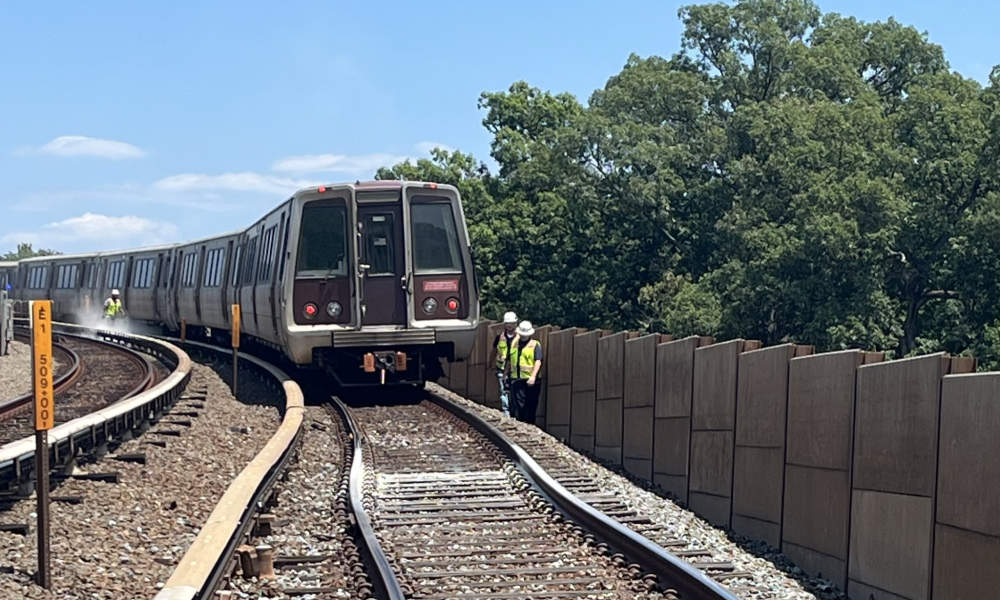
A Washington Metro train derailed near College Park, Maryland on Saturday after what the transit agency described as a heat-related rail “kink,” forcing 11 passengers to evacuate and sending one adult male to hospital for evaluation. According to BNO News, the incident occurred around midday and disrupted Green Line service as crews prepared to remove the train overnight. WMATA said a preliminary investigation linked the derailment to extreme heat.
The derailment is a small incident with a large operational message. WMATA responded by single-tracking trains between West Hyattsville Crossing and College Park through the end of service, and by cutting speeds to 35 mph on aboveground tracks across the system under its standard procedures. That kind of systemwide slowdown is a blunt instrument: it reduces the risk of additional failures, but it also reduces capacity precisely when heat pushes more riders toward air-conditioned transit and away from walking, cycling, and driving.
Heat kinks are not a novel engineering problem, but they are a recurring accountability problem. Track expansion under high temperatures is predictable; what varies is how much margin is built into maintenance schedules, inspection regimes, and capital renewal plans. When an agency is funded through a mix of fares and political appropriations, the incentives tilt toward visible ribbon-cutting and away from invisible resilience work that prevents a rail from warping on a Saturday in July.
The public experiences the outcome as service uncertainty: evacuations, reduced frequency, and long waits. The agency experiences it as a safety event that justifies conservative operating rules, slower speeds, and more overtime. Each incident also creates its own paperwork and public-relations cycle, while the underlying question—how much track, power, and rolling stock can be kept within safe tolerances during extreme weather—gets answered in practice by restrictions that riders absorb as lost time.
Fire officials initially said three people were evaluated before later reporting that one person refused transport and one adult male was taken to hospital, underscoring how quickly basic facts are revised in the first hours of a disruption. WMATA said all 11 passengers were safely evacuated.
The train left the tracks near College Park, and Metro’s immediate fix was not a new piece of infrastructure but a slower system.