
Ukrainian drones hit St Petersburg oil terminal
Regional governors report wider strikes on Baltic port area, Moscow downplays damage as Ukraine targets war revenue
Images
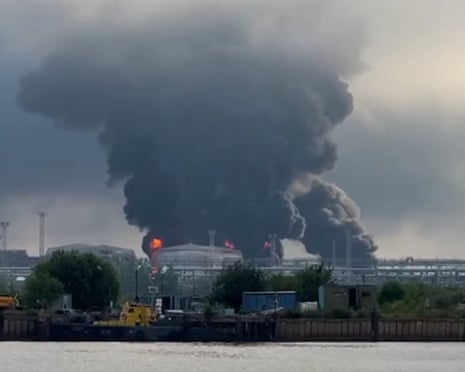 Smoke rises from fires after drone attacks on oil and port facilities in the St Petersburg region in this screengrab from a video posted to social media by Ukraine’s president, Volodymyr Zelenskyy. Photograph: zelenskyy_official
theguardian.com
Smoke rises from fires after drone attacks on oil and port facilities in the St Petersburg region in this screengrab from a video posted to social media by Ukraine’s president, Volodymyr Zelenskyy. Photograph: zelenskyy_official
theguardian.com
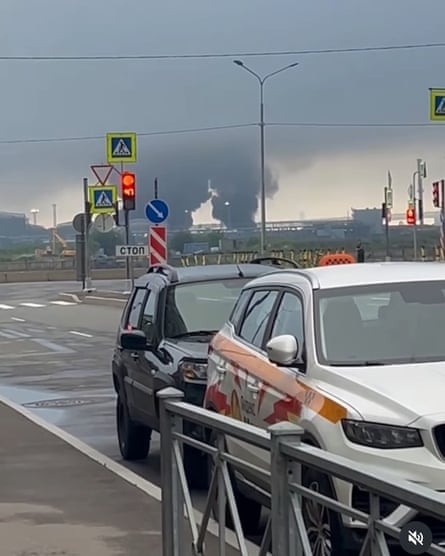 Volodymyr Zelenskyy describes the attacks as part of Ukraine’s continuing ‘long-range sanctions’ against Russia. Photograph: zelenskyy_official
theguardian.com
Volodymyr Zelenskyy describes the attacks as part of Ukraine’s continuing ‘long-range sanctions’ against Russia. Photograph: zelenskyy_official
theguardian.com
Ukrainian drones struck oil and port infrastructure around St Petersburg overnight, Russian regional governors said, in one of the deepest reported attacks of the war. Alexander Beglov, St Petersburg’s governor, described a “large-scale” strike on the city’s oil terminal and said there were no casualties, while Leningrad region governor Alexander Drozdenko said a drone hit the Vysotsk port area.
According to the Guardian, Drozdenko said 72 drones were shot down over the Leningrad region, with minor damage reported in several settlements. He did not provide details on the impact at the port itself. Vysotsk is a Baltic Sea port that handles oil, grain, coal and liquefied natural gas, making it part of the export and logistics system that keeps Russian budget revenues flowing despite sanctions.
Kyiv has increasingly treated energy and transport nodes not as civilian backdrops but as cash registers for the war. President Volodymyr Zelenskyy framed the strikes as “long-range sanctions” aimed at port oil infrastructure that generates revenue for Russia’s military campaign. The language matters: sanctions are normally something states impose through laws and banking restrictions; drone raids impose costs directly, in repair bills, disrupted operations and higher insurance and security spending.
Moscow’s public messaging has tended to minimise such attacks. Vladimir Putin dismissed strikes on energy facilities as “not critical”, the Guardian reports, even as Russia has been forced in past waves of attacks to juggle refinery outages and fuel logistics across a vast territory. The same pattern applies to air defence claims: regional officials list large numbers of intercepted drones, while offering sparse information about what was hit and what stopped working.
The St Petersburg operation also sits alongside a broader overnight picture of pressure on multiple fronts. The Guardian reports that officials in Russia’s Bryansk region and in Russian-occupied Crimea said drone strikes killed one person and wounded several, while Pskov region reported more than 30 drones shot down and minor damage including at a factory in Velikiye Luki.
Zelenskyy also used the moment to rebut Russian battlefield claims. After Russia’s military told Putin its forces had taken the eastern city of Kostiantynivka, Zelenskyy called the claim untrue, and Ukraine’s general staff said the city remained under Ukrainian control.
Beglov said the aftermath in St Petersburg had been dealt with. Drozdenko said 72 drones were shot down, and did not say what Vysotsk’s operators found when daylight arrived.