
Jonathan Freedland questions US democratic model at 250 years
Guardian column links Trump return to imperial presidency and identity politics, personal wealth and state power start to look like the same ledger
Images
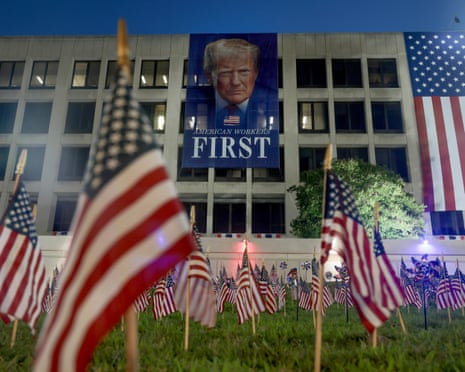 The US Department of Labor building, Washington DC, 3 July 2026. Photograph: Joe Raedle/Getty Images
theguardian.com
The US Department of Labor building, Washington DC, 3 July 2026. Photograph: Joe Raedle/Getty Images
theguardian.com
 Jonathan Freedland
theguardian.com
Jonathan Freedland
theguardian.com
On the United States’ 250th anniversary Jonathan Freedland describes a divided country and an embattled constitution, arguing that Donald Trump’s return to office has turned old American contradictions into live political practice. Writing in the Guardian, Freedland frames the milestone against a founding that promised equality while excluding women and coexisting with slavery, and he leans on Benjamin Franklin’s warning that a republic lasts only “if you can keep it.”
Freedland’s case rests on a familiar American pattern: institutions built to limit power repeatedly expand it in moments of fear, war, or partisan emergency. He notes that Abraham Lincoln imposed martial law and suspended habeas corpus during the Civil War, and that Franklin Roosevelt drew accusations of creating an “imperial presidency.” The novelty, in his telling, is not that the system strains, but that the strain now sits at the centre of national identity. He writes of an administration that is not merely exploiting the tools of the modern presidency but seeking to redefine what the country is for, contrasting an older “creedal” self-image with a more ethnic understanding of belonging.
That argument lands differently from Europe, where American power is experienced less as an inspiring civic seminar than as a set of hard constraints: sanctions regimes, security guarantees with conditions attached, and a permanent capacity to turn domestic political swings into external shocks. Freedland says Trump has worked to dismantle the post-1945 rules-based international order and launched a war that strengthened Iran while weakening the US. For allies, the practical question is not whether Washington’s ideals remain rhetorically intact, but whether the US state can still price the costs of its own decisions, or whether those costs are routinely exported.
Freedland also points to money and office converging in ways that make constitutional guardrails look procedural. He cites reporting that Trump personally earned $2.2 billion in his first year back in office, a figure that, if accurate, would make the presidency resemble a revenue stream as much as a public trust. The piece’s subtext is that America’s internal checks are only as strong as the people willing to enforce them—and that enforcement becomes harder when politics turns into a fight over who counts as “the people” in the first place.
The United States has survived civil war, Jim Crow and McCarthyism, Freedland writes, and it remains militarily and economically formidable. It is marking 250 years since 13 colonies declared independence from Great Britain. The anniversary arrives with the constitution still in place, and with the question of who benefits from power still being renegotiated in public.